Kay Swift was the first woman to compose an entire Broadway score. The show was
Fine and Dandy, a confection tailored to the talents of a little remembered comic named Joe Cook. During the 1930-31 theater season,
Fine and Dandy ran neck and neck with the Gershwins' hit
Girl Crazy. Swift wrote a handful of songs (such as "
Can This Be Love?," "
Whistling in the Dark," and "
Can't We Be Friends?") that are familiar from recordings, cabaret interpretations, and the waves of Muzak that form the soundtrack for contemporary urban life. Despite all of this, Kay Swift isn't a household name. For posterity, she's linked to the Gershwins, but the link isn't
Girl Crazy or anything musical; it's her long love affair with the elusive bachelor George Gershwin.
Born into a well-educated family on the Upper West Side of Manhattan, Katharine Swift was surrounded from early childhood by artists and their art. Her father, a music critic, took her regularly to the concerts that he covered, and she prowled the backstage corridors of the old Metropolitan Opera House with a close comrade whose mother was one of the company's stars. At the Institute of Musical Art (subsequently Juilliard), Swift received a rigorous musical education and made contacts that would serve her well for years to come. Soon after graduation, she married James Paul Warburg, scion of the German-American banking family that controlled M.M. Warburg in Europe and Kuhn, Loeb in the United States. The newlyweds were conspicuous in Manhattan's Jazz Age society, socializing with the Irving Berlins, the Cole Porters, and the Algonquin wits. At their homes in New York City and Greenwich, Connecticut, Katharine and James threw Gatsby-scale parties that made them catnip for the gossip columns.
Defying social position and maternal obligations, Swift became a Broadway
 |
| Kay and George |
rehearsal pianist and professional composer. She understood implicitly the conventions of both classical and popular music. Endlessly inventive, she had a knack for experimenting with rhythm, harmony, and melody that made all of her songs arresting and the best of them unpredictable. With her taste for leopard print clothes and zebra skin décor, Swift had personal flair, as well. If she was an anomaly in the Warburgs' world, her husband was, too; beneath a bland banker's exterior, James Paul Warburg concealed a poetic sensibility and a gift for rhyme. Using the nom de plume Paul James, he served his wife as lyricist on Fine and Dandy and a number of popular songs.
Both Swift's marriage to Warburg and her professional momentum appear to have been in jeopardy from the moment she crossed paths with George Gershwin; when the two met at a party in 1925, their attraction was, reportedly, immediate and evident to all in the room.
For Swift, Gershwin may have offered a jaunty, rough-edged contrast to Warburg's Harvard-honed suavity. She coached him in etiquette and how to dress for mixing with the upper crust. Because Gershwin's formal musical education had been modest, she tutored him in counterpoint and orchestration. Together, they studied advanced music theory. Adept at taking musical dictation, Kay notated Gershwin's compositions as they flowed from his exuberant imagination. To her this must have seemed like peeking into the inner reaches of his creativity. As though to suggest that they'd come to view the world from the same perspective, she gave him a watch fob shaped like a dove, with gems as its eyes -- one a sapphire, George's birthstone; the other a diamond, which was Kay's. Gershwin wore it as a talisman when he performed in public.
 |
Kay and George Gershwin at Kay’s home, Bydale, in Greenwich, CT. |
There are many ways in which one might assemble the puzzle pieces of this relationship. But, to quote a Paul James lyric from Swift's most famous song, "this is how the story ends": Swift subordinated her creativity to the service of Gershwin's genius, functioning as his amanuensis and writing little or nothing of her own for the four years that followed the premiere of Fine and Dandy. Despite the magnitude of that sacrifice, she didn't succeed in her apparent plan to meld her life to his. Oscar Levant, well-acquainted with Gershwin's wandering eye and his wariness to commit, quipped: "Ah, look! Here comes George Gershwin with the future Miss Kay Swift!" Gershwin was known to find married women safer bets than single ones. Perhaps Swift's availability after she divorced Warburg made her less attractive and more intimidating to him, or perhaps they both were astute enough to figure the lousy odds of Gershwin curbing his well-known yen for variety. Whatever the reason, Kay and George went their separate ways when the Gershwin brothers left for Hollywood in the summer of 1936. Less than a year later, at age 38, George died of a brain tumor.
After Gershwin's death in 1937, Ira Gershwin collaborated with Swift to complete and arrange some of his unpublished works. He said that she knew almost all of George's music, "had taken down sketches as he composed and had total musical recall."
Read more

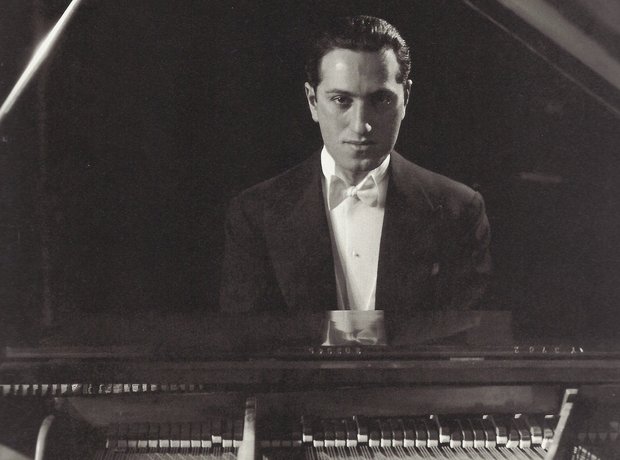
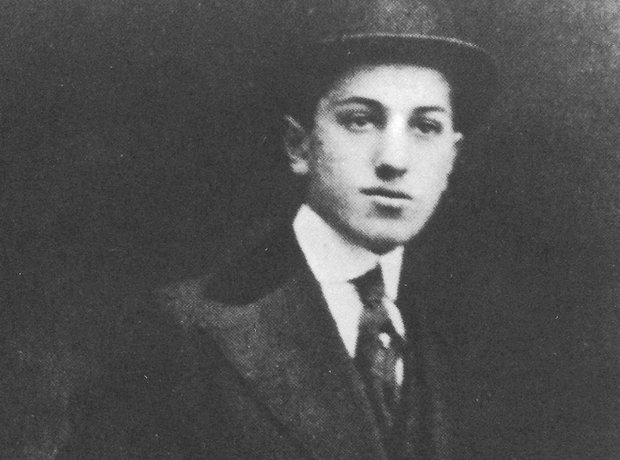 The acclaimed piano teacher Charles Hambitzer took Gershwin on at the age of 14 and immediately realized the level of talent he had on his hands. ‘I have a new pupil who will make his mark if anybody will. The boy is a genius,’ Hambitzer wrote to his sister. Gershwin was sent off to concerts and given significant pieces by the great composers to learn for the piano. Hambitzer's efforts certainly paid off.


