Showing posts with label NPR. Show all posts

NPR Revisits The The Pioneering Composer Florence Price


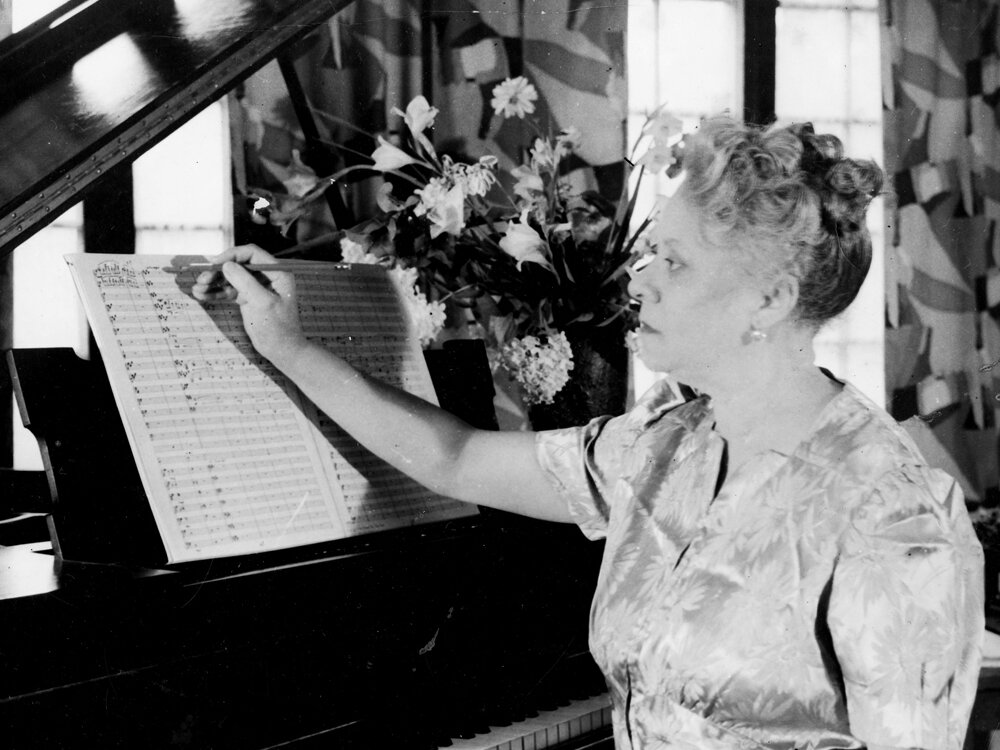
In 1933, the Chicago Symphony Orchestra gave the world premiere of Symphony No. 1 by a then little-known composer named Florence Price. The performance marked the first time a major orchestra played music by an African-American woman. Price's First Symphony, along with her Fourth, has just been released on an album featuring the Fort Smith Symphony, conducted by John Jeter. Fans of Price, especially in the African-American community, may argue that her music has never really been forgotten. But some of it has been lost. Not long ago, a couple bought a fixer-upper, south of Chicago, and discovered nearly 30 boxes of manuscripts and papers. Among the discoveries in what turned out to be Price's abandoned summer home was her Fourth Symphony, composed in 1945. This world-premiere recording is another new piece of the puzzle to understanding the life and music of Price, and a particular time in America's cultural history.

Price was born in 1887 in Little Rock, Ark. Her mother gave her music lessons since none of the leading white teachers in town would take her. In 1904, Price enrolled at the New England Conservatory in Boston, one of the few music schools to accept black students at the time. After earning two diplomas, she returned to Little Rock, where she taught, got married, and began raising a family. But racial tensions were on the rise, and a downtown public lynching in 1927 triggered a move to Chicago.

There, Price blossomed as a composer. Her First Symphony won a composing prize, which caught the attention of conductor Frederick Stock, who led the premiere of the piece with his Chicago Symphony Orchestra. The music is a blend of two traditions — African-American and European. The opening movement is reminiscent of Dvorak's "New World" Symphony, with its portentous sweep and lyrical melodies.

Price might be searching for her own voice in her First Symphony, but she adds distinctive touches. Cathedral chimes glisten in the serene slow movement, where a brass choir converses with delicate winds. In the third movement, African drums accompany a syncopated "Juba Dance," a folk tradition that originated in Angola and moved, with slaves, to American plantations.

 Price and her music were well received in Chicago. The great contralto Marian Anderson closed her legendary 1939 Lincoln Memorial concert with a piece arranged by Price. Still, she scraped to make ends meet, writing pop tunes and accompanying silent films. In 1943, she sent a letter to Serge Koussevitzky, conductor of the Boston Symphony Orchestra, acknowledging what she was up against. "I have two handicaps," she wrote: "I am a woman and I have some Negro blood in my veins."

 But Price pushed on. Two years later, she wrote her final symphony, the newly resurrected Fourth. In the opening movement, she quotes one of the most famous spirituals, "Wade in the Water." Price adds another "Juba Dance" for the third movement, and concludes with a bustling Scherzo that alternates serious and lighthearted episodes, ending with a bang.

Florence Price was celebrated in her day. But her untimely death in 1953, and the amount of music she composed but was never heard, helped dim her reputation over the years — until now. Tucked away in those 30 recently discovered boxes are some 200 compositions, which librarians and scholars are currently poring over. Clearly, Florence Price's story is far from over.

Read more


The Story Behind Gershwin's "Rhapsody in Blue."


At age 25, took only three weeks to compose one of the most enduring pieces of American music. Used for the film score to Woody Allen's Manhattan, the episodic and jazzy one-movement piano concerto evokes the hustle and bustle of New York's grand metropolitan aura.

NPR's Jeff Lunden tells the story of Gershwin's most identifiable masterpiece.


Rhapsody In Blue: Gershwin At His Greatest


On June 23rd, 1959, Leonard Bernstein and the Columbia Symphony took their places at the St. George Hotel in Brooklyn, N.Y. and made a landmark recording of Gershwin's 'Rhapsody in Blue.'

Rhapsody In Blue, the first "serious" composition by George Gershwin (1898-1937), is likely to remain his most popular work in any form, more for its prodigious melodic richness rather than for any deeper expressiveness or structural brilliance. 

 In the hands of another composer, Rhapsody In Blue could easily have turned into a disjointed exercise in symphonically dressed up jazz rhythms, melodic figures and quasi-improvisatory instrumental licks. Instead, Gershwin's uncanny sense of timing, and a gift for memorable melody unparalleled in the 20th century, turned the Rhapsody into an embodiment of the Jazz Age's upbeat lyricism and dance-driven vitality. The roaring Twenties had a soul, and this was it. 

The piece was composed in considerable haste, for a concert on February 12th, 1924, organized by jazz bandleader Paul Whiteman. It took place at New York's Aeolian Hall, billed as an "Experiment In Modern Music." The piece was scored for jazz band by Whiteman's arranger, the multitalented Ferde Grofé, and Gershwin himself played the piano solo — though at the time of the premiere he had not yet written it out. Grofé also scored the work's orchestral version.

Listen to the entire Rhaspsody in Blue

A Violin Concerto Back From Beyond The Grave

Schumann Violin Concerto, a work buried for nearly a century and recovered — or so the story goes — by a message from the beyond.


In the summer of 1853, the young violinist Joseph Joachim asked a friend, pianist, composer and conductor Robert Schumann, to write a violin concerto for him. Schumann, though suffering from depression, went into a frenzy of activity, completing the Violin Concerto in D Minor (fully scored for all the different musical parts) within 13 days in late September and early October. Within months, however, the composer attempted suicide and was confined to an asylum until his death two years later at the age of 46.

Neither Joachim nor Schumann's wife, Clara, nor their young friend Johannes Brahms, thought the piece was good enough. In fact, Clara didn't like much of what Schumann wrote in those last years, according to Christoph Eschenbach, music director of the National Symphony Orchestra in Washington, D.C. She was a famous pianist and musical personality and, Eschenbach maintains, she used her influence with the younger Joachim and Brahms to bury the Violin Concerto.

"Brahms was easy to convince that she was right, and there is also the story of the love affair between Clara and Brahms," says Eschenbach, who notes speculation that the alleged love affair might have caused Schumann's suicide attempt.

The concerto was not performed or published, and it would end up in the Prussian State Library in Berlin, with the proviso that it not be performed for 100 years after the composer's death. But a grandniece of the violinist for whom the concerto was written had an interest in the occult — as did the Schumanns. Her name was Jelly d'Arányi and she too was a violinist. At a seance, she is said to have received word from the beyond urging her to find and perform an unpublished work for the violin. Who, she asked, is the composer of this work? The dial on the Ouija board is said to have pointed to the letters spelling out the name: Robert Schumann.

Maestro Eschenbach treats all of this with a grain of salt, but the fact is d'Arányi somehow tracked down the concerto in the Prussian State Library. "Because she wanted to play it," Eschenbach says, "but Berlin said no, no, no, no, no."

The year was 1933, and Hitler's Germany wanted a German to play the debut performance. The honor went to Georg Kulenkampff, who played the premiere four years later. "He was unfortunately not so good a violinist," Eschenbach says, "but a terribly good Nazi."

Famed violinist Yehudi Menuhin loved the piece, calling it the "bridge" between Beethoven and Brahms, and he played the American debut shortly thereafter. D'Arányi played the British debut. But only recently has the concerto been played more and more. Eschenbach's eyes sparkle when he talks about the piece, calling it "visionary" and "courageous for its time."


Of the beautiful and heart-wrenching second movement, Eschenbach says, "When you listen to this very simple theme, it is so from deep down and so heartbreaking." Schumann would write variations on this theme, which, like the Violin Concerto, were suppressed until the 1930s. They are now known as the Ghost Variations.

Reposted from NPR


Three Quick Lessons From The Violin Wunderkind Who Became A Master


Joshua Bell was once a boy wonder of the violin. Now, at 46, he leads nine young musicians in Masterclass. HBO's 30-minute documentary series pairs young artists with world-renowned mentors such as Placido Domingo, Frank Gehry and Patti LuPone, and gives both the teacher and the students opportunities to learn from each other. During an interview with NPR's Robert Siegel, Bell offers three solid pieces of advice to musicians new and old:


    "It's important to understand] your role in playing chamber music."

    "The key is to figure out what you're contributing. If it's rhythm, then you don't want to drown everyone out. You want people to understand the rhythmic basis."

    "To play with great energy and great character within [the soft dynamic] piano is something that one needs to learn how to do."


Simone Dinnerstein Plays Bach's Inventions


Almost any pianist, from a budding beginner to a pro like , will tell you that one of the basic techniques of keyboard playing is also the toughest to master: making your hands to do separate things simultaneously. 

The great knew this to be true. That's the primary reason he composed his Two-Part Inventions. On one hand (pardon the metaphor) they are rigorous exercises he wrote in the 1720s for the musical education of his children and students. On the other hand, as Dinnerstein told the audience at this Tiny Desk Concert, they are "an endless well of musical knowledge and imagination." Some of the Inventions zing with the speed of a sewing machine. Others dance and some unfold like a gentle aria. 

Dinnerstein learned a number of Bach's Two-Part Inventions as a youngster. Later she used them to teach her own students how to divide their brains. And now, as an adult musician with a major career, she has returned to these deceptively simple pieces, finding their complexity especially satisfying. 

She also likes the way the inventions force the player to make the piano sing. That's not easy when you consider the piano is actually a percussion instrument of wires and hammers concealed inside a box. Bach himself noted that they are good not only for playing "neatly in two parts" but also "to achieve a cantabile style of playing." That's musical jargon for playing the music in a singable style. And oh how poetically Ms. Dinnerstein makes our Tiny Desk piano sing. 

 J.S. Bach: Inventions Nos. 1, 6, 8,
J.S. Bach: Inventions Nos. 9, 10,
J.S. Bach: Inventions Nos. 12, 13, 14

A Languid Look Back To Gershwin's 'Summertime'


"Summertime" might be the opening word in 's iconic song, but as Rob Kapilow points out to host Fred Child, that's not where the music really starts. The eight instrumental measures that open the song, Kapilow says, set up an evocative transition into the languid world of Catfish Row.

A single note pushes us into Gershwin's South Carolina setting.

"Then the clarinet floats in from the heavens," Kapilow says, "bringing in the other two notes we need to establish: not just Catfish Row, but the character of Clara, rocking her baby, because 'Summertime' is actually a lullaby."

One of the keys to the song's greatness, Kapilow maintains, is its simplicity. From two gently swaying notes, Gershwin adds rich harmony.

"It's like black-and-white being filled into Technicolor, right as the voice comes in," Kapilow says. "An exquisite cross-fade: one note, a rocking theme, slow it down, and then harmony. That languid slowness of summer is also in the fantastic rhythm in the first word, 'summertime,' where the last syllable gets stretched on that beautiful high note. Somehow, we're in this incredibly languid world within two notes."


Why Being Stuck On A Tarmac With The Philly Orchestra Rocks

There are few things as annoying as being stuck on a tarmac — in a cramped, packed plane — for long periods of time. But when you have some of the members of the Philadelphia Orchestra on your flight, it could turn magical.

No, seriously.

It happened to passengers on a flight from Beijing to Macau, this week. They had been sitting on the tarmac for three hours when a quartet of musicians from the Philadelphia Orchestra pulled out their instruments and provided a "Pop Up" performance.


The orchestra published video of the performance:

.

Playing Mozart — On Mozart's Violin


The violin and viola that played himself are in the United States for the first time ever. The instruments come out of storage only about once a year at the Salzburg Mozarteum in Austria. The rest of the time, they're kept under serious lockup. Musicians who got to play them aearlier this week before the violin's New York premiere on June 14th. 

Imani Winds: Tiny Desk Concert


When Igor Stravinsky began composing The Rite of Spring, his ballet for vast symphonic forces, he could hear the music in his head but couldn't quite figure out how to write it down. It was just too complicated.

Today, 100 years after The Rite's premiere, the fearless musicians of Imani Winds make it all sound remarkably easy, given that they've condensed Stravinsky's massive walls of sound down to just five instruments: bassoon, clarinet, flute (doubling on piccolo), oboe and French horn.

Israel Kamakawiwo'ole: The Voice Of Hawaii

 
The late Hawaiian musician Israel Kamakawiwo'ole (Kah-MAH-kah-VEE-voh-OH-lay), did something rare in music. He redefined a beloved classic.

His version of "Over the Rainbow" has the poignancy of Judy Garland's and the shimmering vulnerability, but these days it's heard so often on TV and in the movies, a younger generation may only know Israel's version. It's become so popular, it is now the most requested version of the song by far, according to music publishing house EMI. That's quite remarkable for a rendition with one voice, accompanied only by ukulele.

"In Hawaii, we talk about this thing we call mana," says musician Del Beazley, who grew up with Israel and wrote two of his songs. "Mana is like an energy that you get. We believe we get ours from the elements first, the Earth, your sky, your ocean, your God, and all that is inside of us. And when we open our mouth to speak, to sing or to play, that's what we let out. But it's that that makes him [Israel] special, because his mana always came out."

Beazley remembers the first time he heard Israel sing.

They were teenagers and Israel showed up with his older brother Skippy at a graduation party.

"They set up with instruments that were kind of beat up. In fact, one of the ukuleles was held together with bubble gum. What happened was, as soon as Israel Kamakawiwo'ole opened his mouth and sang, that whole place went quiet. Every great singer has something special. It's almost a nasal or head tone. And that thing just cut right through the air, stopped everybody in their tracks."

Israel was still a teenager when he and his brother formed a band with three other local guys. They called themselves the Makaha Sons of Ni'ihau. In the 1970s, young Hawaiians were rediscovering their language and culture. In music, that meant getting away from kitschy hula tunes for tourists, like "My Little Grass Shack." Israel's group was among those who embraced traditional melodies.

Israel was the group's standout — for his voice and also his size. Both he and Skippy weighed hundreds of pounds — the girth of sumo wrestlers. Israel was over 6 feet tall with flowing black hair.

The 1988 Recording Session That Made Him A Legend

It began at 3 in the morning. Milan Bertosa was at the end of a long day in his Honolulu recording studio.

"And the phone rings. It was a client of mine," Bertosa remembers. The client rattled off Israel's unpronounceable name and said he wanted to come in and record a demo. Bertosa said he was shutting down, call tomorrow. But the client insisted on putting Israel on the phone. "And he's this really sweet man, well-mannered, kind. 'Please, can I come in? I have an idea,' " Bertosa remembers Israel saying.

Bertosa relented and gave Israel 15 minutes to get there. Soon, there was a knock at the door.

"And in walks the largest human being I had seen in my life. Israel was probably like 500 pounds. And the first thing at hand is to find something for him to sit on." The building security found Israel a big steel chair. "Then I put up some microphones, do a quick sound check, roll tape, and the first thing he does is 'Somewhere Over the Rainbow.' He played and sang, one take, and it was over."

The next day, Bertosa made a copy for Israel and filed the original recording away. But he was so taken with it, that over the next few years, he played it occasionally for family and friends. "It was that special," he says. "Whatever was going on that night, he was inspired. It was like we just caught the moment."
Web Extra: Isreal Speaks

Jump Ahead Five Years

In 1993, Milan Bertosa wound up working as an engineer for Mountain Apple Company in Honolulu, a long-established recording house, where Israel was making a solo album. As Bertosa listened during the final days of recording, he had an epiphany. He turned to producer Jon de Mello and said, "This is great, but there's more." Bertosa fished out "Over the Rainbow" and played it for de Mello.

"Israel was really sparkly, really alive," recalls de Mello after hearing the recording. "He had a grand heart attack in 1989, so this was right before his heart attack." De Mello put "Over the Rainbow" (actually a medley, with "What a Wonderful World") on Facing Future, which is still the best-selling Hawaiian album of all time, thanks to one song.

"There's been a bunch of articles written about 'Over the Rainbow,' " says Bertosa. "He gets the lyrics wrong, he changes the melody. If you sat there with a book and a score card, you could count the mistakes or you could listen to the song and smile."

Family Struggles

Israel weighed close to 700 pounds when he came to de Mello to start a solo career in 1993. He was in and out of the hospital.

His brother Skippy died from complications of obesity, as had almost all of Israel's immediate family. He knew he was destined for a brief life. To de Mello, everything Israel sang and said became precious. So he instructed his engineers to keep the tape rolling for all the rehearsals, all the jokes.

Israel was a very funny man, he says. "And every session, I would keep him for an hour afterwards." Just tell me stories, he told Israel. "There was such great content in what this beautiful Hawaiian man was talking about — the trials and tribulations of his own life and his family's life."

"I was scared when I lost my mother, my father, my brother, my sister," Israel told de Mello. "I guess this is gonna sound kind of weird, but I'm not scared for myself for dying. Because I believe all these places are temporary. This is just one shell. Because we Hawaiians live in both worlds. It's in our veins. When our time come, don't cry for me. Don't cry for me. Plant a tree in the middle ... where they play soccer," he laughs. "Kind of small, then I'll grow big."

In the summer of 1997, Israel Kamakawiwo'ole , by then one of the most beloved singers in the history of Hawaiian music, died of respiratory failure. He was 38 — and just beginning to see the huge success of "Over the Rainbow."

Israel's body lay in state at Hawaii's Capitol building, a rare honor.

Days later, he was cremated, along with his vintage Martin ukulele — the one he used to record "Over the Rainbow." The ashes were carried on a traditional Hawaiian voyaging canoe.

His longtime friend Del Beazley and producer Jon de Mello were among those onboard.

"And going down the coastline," says de Mello, "all the big semi-trucks on the island of Oahu had their air horns blowing. And from the ocean we could hear the echo, the bounce off the mountain ranges."

"In the old days," says Beazley, "people would wail when the mo'i or 'king' passed away — and cry. And that's really what it was. This whole island came together just to say goodbye to this one Hawaiian. But I tell you, he would have been laughing."


Rhapsody In Blue: Gershwin At His Greatest


On June 23rd, 1959, Leonard Bernstein and the Columbia Symphony took their places at the St. George Hotel in Brooklyn, N.Y. and made a landmark recording of Gershwin's 'Rhapsody in Blue.'

Rhapsody In Blue, the first "serious" composition by George Gershwin (1898-1937), is likely to remain his most popular work in any form, more for its prodigious melodic richness rather than for any deeper expressiveness or structural brilliance. 

 In the hands of another composer, Rhapsody In Blue could easily have turned into a disjointed exercise in symphonically dressed up jazz rhythms, melodic figures and quasi-improvisatory instrumental licks. Instead, Gershwin's uncanny sense of timing, and a gift for memorable melody unparalleled in the 20th century, turned the Rhapsody into an embodiment of the Jazz Age's upbeat lyricism and dance-driven vitality. The roaring Twenties had a soul, and this was it. 

The piece was composed in considerable haste, for a concert on February 12th, 1924, organized by jazz bandleader Paul Whiteman. It took place at New York's Aeolian Hall, billed as an "Experiment In Modern Music." The piece was scored for jazz band by Whiteman's arranger, the multitalented Ferde Grofé, and Gershwin himself played the piano solo — though at the time of the premiere he had not yet written it out. Grofé also scored the work's orchestral version. Listen to the entire Rhaspsody in Blue

Richie Havens

The crowd at Richie Havens' Woodstock-opening set on Aug. 15, 1969.                          

Richie Havens once told NPR that he believed all music is folk music. Listen to Havens speak about Woodstock, Greenwich Village and why he loved performing in Neda Ulaby's remembrance, broadcast on Morning Edition, at the audio link on this page.


Classical Masterpieces Turn Up in Cartoons

Music Historian Rober Greenberg talks about the way cartoons draw on an unlikely music source:


Cartoons made in the 1940s and '50s featured characters like Bugs Bunny, Woody Woodpecker and Elmer Fudd pretending to play significant operatic and symphonic works or feuding with their sworn enemies to the tune of epic masterpieces. Many children became familiar with classical music through these cartoons. Music historian Robert Greenberg talks about how that came to be and discusses the impact of cartoons on classical music.

Hollywood Bowl
The Los Angeles Philharmonic performs at the Hollywood Bowl as the cartoon "Baton Bunny" plays overhead.

Bugs Bunny was quite the concert musician. In "Rhapsody Rabbit," he attempted to perform Liszt's "Hungarian Rhapsody No. 2" despite a coughing audience member (whom Bugs shoots), a ringing telephone and a bothersome mouse. He conducted an orchestra at the Hollywood Bowl in "Long-Haired Hare."

The animated films Fantasia and The Sorcerer's Apprentice featured many different musical works. Fantasia, from 1940, featured music from Mussorgsky and Schubert. The film marked an attempt to create an "integrated" art form — what Wagner called Gesamtkunstwerke, a virtual reality that combined music and animation and virtually no dialogue. The music was recorded under the direction of Leopold Stokowski, with seven numbers performed by the Philadelphia Orchestra. The Sorcerer's Apprentice was originally a stand alone film based on a story by Goethe and the music of Paul Dukas. At Stokowski's suggestion, Disney expanded the film into Fantasia, which also featured music by Bach, Tchaikovsky and Stravinsky.

Meet The Musical Mendelssohns: Felix And Fanny

Fanny and Felix Mendelssohn relied on each other to shape their very different musical careers.

Musical talent tends to run in families. Think of Ann and Nancy Wilson of Heart, Rufus and Martha Wainwright, Colin and Jonny Greenwood of Radiohead, or The Jackson 5.

But long before those musical siblings, there were the Mendelssohns — Felix and Fanny, the subjects of a new album by the versatile Ebène Quartet from Paris.

The Mendelssohns grew up making music together in Berlin at the beginning of the 19th century. Felix, younger by four years, became one of history's most brilliant composers. Fanny, a strong-willed pianist but worried about her worth as a composer, has been neglected. Still, as Felix's career soared and Fanny struggled to publish her pieces, the two remained close.

"The connection between Fanny and Felix was more than brother and sister," Ebène cellist Raphaël Merlin says. "It was almost soul mates."


Other than playing and conducting in salon settings, Fanny made just one public appearance, as soloist in her brother's First Piano Concerto at a benefit concert. Very little of her music was published in her lifetime, and much of it today remains privately owned.

Fanny died suddenly of a stroke at age 41, in 1847. Felix was crushed, and Herzog says you can hear the pain he poured into the String Quartet No. 6 in F minor, completed in September of that year.

"Felix Mendelssohn's music is always a joy. He's an optimistic guy," Herzog says. "In this quartet you feel immediately that there's something strange. You will be shocked by music with so much power and drama."

"And violence," Merlin adds.

Felix referred to the quartet as his "Requiem for Fanny." He would die two months later, at 38, after a series of strokes. He was buried next to his sister in Berlin.

"We think he died of sadness," Herzog says.


Listen to String Quartet in E-flat: Allegro molto vivace

Do Orchestras Really Need Conductors?


Does This Guy Matter? Conductor Leonard Bernstein during rehearsal with the Cincinnati Symphony at Carnegie Hall in 1977.


Have you ever wondered whether music conductors actually influence their orchestras?

They seem important. After all, they're standing in the middle of the stage and waving their hands. But the musicians all have scores before them that tell them what to play. If you took the conductor away, could the orchestra manage on its own?

A new study aims to answer this question. Yiannis Aloimonos, of the University of Maryland, and several colleagues recruited the help of orchestral players from Ferrara, Italy.

They installed a tiny infrared light at the tip of an (unnamed) conductor's baton. They also placed similar lights on the bows of the violinists in the orchestra. The scientists then surrounded the orchestra with infrared cameras.

When the conductor waved the baton, and the violinists moved their bows, the moving lights created patterns in space, which the cameras captured. Computers analyzed the infrared patterns as signals: Using mathematical techniques originally designed by Nobel Prize-winning economist Clive Granger, Aloimonos and his colleagues analyzed whether the movements of the conductor were linked to those of the violinists.

The scientists hypothesized that if the movement of the conductor could predict the movements of the violinists, then the conductor was clearly leading the players. But if the conductor's movements could not predict the movement of the violinists, then it was really the players who were in charge.

"You have a signal that is originating from the conductor, because he is moving his hands and his body," Aloimonos explained. "And then the players, they perceive that signal, and they create another signal by moving the bows of the violin appropriately. So you have some sort of sensorimotor conversation."

(The research study is part of a larger project where Aloimonos is trying to figure out if human movements share something in common with human language; he suspects both are not only governed by a grammar, but that both may be based on similar processes in the brain.)

Aloimonos said the study found that conductors were leading the violinists — the movement of the conductors predicted the movement of the violinists, not the other way around.

But the study found more: The scientists had two conductors lead the same orchestra. One was a veteran who exercised an iron grip over the violinists. The other was an amateur.

"What we found is the more the influence of the conductor to the players, the more aesthetic — aesthetically pleasing the music was overall," Aloimonos said.

Music experts who listened to the performance of the orchestra under the control of the two conductors found the version produced by the authoritarian conductor superior. Remember, these experts didn't know which version was being led by the veteran conductor and which by the amateur. All they heard was the music.

Kennedy Center's New Organ No Longer A Pipe Dream

Classical 'Rock Star' Joshua Bell Takes On Conducting

 Joshua Bell.


Joshua Bell, the violin prodigy who grew into what some call a classical-music rock star, has taken the helm of the Academy of St. Martin in the Fields. Bell is the orchestra's first music director since Sir Neville Marriner, who created the group.

On his first tour with the group as both music director and conductor, Bell plays the violin while conducting the orchestra simultaneously, gesturing with his bow. And he leads from the concert master's chair, rather than the podium, which seems unusual to some audiences.

But the ASMF orchestra "really knows how to read those sorts of cues," he tells NPR's Neal Conan. In fact, Bell says, Marriner originally led the orchestra from the violin, too.
"So this orchestra, their roots come from being directed from the chair," he says. "Not with a stick."

Who Says Classical Music Can't Be Sexy?

NPR Music


Can you make out to Mozart, or shack up to Chopin? Composers can turn on the sex appeal when necessary.
istock

Can you make out to Mozart, or shack up to Chopin? Composers can turn on the sex appeal when necessary.

With Valentine's Day around the corner, my mind keeps coming back to two things. One of them is music.

The other? Well, I've often wondered why we find plenty of sex in almost all the fine arts — literature, movies, painting, sculpture, opera — but not in the classical concert hall.

Music can be impossibly erotic even if it's not ostensibly about sex — "classics fully clothed," you might say. Maria Joao Pires' performance of the first Nocturne by Chopin is something I find totally steamy. And Jessye Norman's luxurious rendition of Wagner's "Liebestod" is nothing short of a sensual head rush.

It's not easy to depict even a simple kiss in something as amorphous as music, but that doesn't mean composers throughout history haven't tried.

Here are five examples of some really steamy classical music