After Adam Liszt’s death in Bologne-sur-mer in 1827, Franz Liszt met his mother in Paris where they settled down. Liszt, at sixteen, was now the breadwinner of the Liszt family. In order to earn regular income for his mother and himself, Liszt became a piano teacher in Paris for the aristocracy. was sixteen when she met Liszt. He became her piano teacher, and the two quickly fell in love.
Caroline’s lessons were supervised by her mother. Additionally, her mother approved of the relationship. After becoming ill quite quickly in 1828, she told the Count from her deathbed: “If she loves him, let her be happy." The Count likely thought these words were demented mutterings of a woman at death’s door. He probably did not take this comment seriously and therefore was not fully aware of the relationship blooming between Liszt and his student. Caroline’s mother died in June of 1828.
Though the lessons were postponed due to a period of mourning, Liszt continued to stop by the Saint-Cricq home to check on the grieving Caroline. Their lessons resumed, according to Sitwell, the death of Caroline’s mother may have been an excuse to continue lessons as a distraction. The Count was often away on government business, and as such the young couple spent time together daily without supervision. Zsolt Harsányi in his book, Immortal Franz: the Life and Loves of Franz Liszt, mentions an aunt who supervised at first, but their gradually extending lessons tired her and she left the two young people alone.
On one fateful occasion, Liszt stayed conversing on topics such as music, poetry, and religion with Caroline past midnight. He had an encounter with the porter of the Saint-Cricq building when he needed to be let out. Adam Walker claims that Liszt was ignorant of the need to fill the porter’s purse in order to remain anonymous. Derek Watson, alternatively, says that Liszt failed to tip the butler who complained to the Count of the late hour. Either way, the servant in question informed Pierre de Saint-Cricq of this occurrence, and the Count met Liszt the next time the musician stopped by. After reminding Liszt of the difference in class between Caroline and himself, the Count ended the lessons and told Liszt that he was not to return to their household, nor see his daughter again. This class difference was already chafing at Liszt, so it was probably a heavy blow.
From the end of the affair in 1828 to about the time of the July Revolution of 1830, Liszt was depressed and ill. He was mistakenly pronounced dead in October of 1828 by an article published in Le Corsaire.
Liszt was certainly not dead, but his romantic relationship with Caroline de Saint-Cricq was over. Though she played an absent role in his life as the symbol of his first love, he only saw her once again in 1844, at her home in Pau, France. He wrote "Ich möchte hingehn" (I would like to go away), later, inspired by their reunion. According to Adrian Williams, she said that Liszt was the “single shining star” of her life.
A quick look at those who brought music to the Sun King’s palace
Louis XIV was crowned King of France in 1654. His reign of 72 years and 110 days is the longest recorded of any monarch in European history, and he is often seen as the echt example of an absolute monarch – his power, so he perceived, came directly from God. His enthusiasm for the arts brought about musical riches that were the envy of Europe, and influenced composers for years to come. While the French court was aware of Italian operatic practices, the musical styles that developed there in the late 17th century were considerably different. Castrati were not a common sight in France, and there was a significant emphasis on vocal and instrumental technique rather than the acrobatic, virtuosic performances seen in Italy. Here, we introduce four of the composers present at Louis XIV's court, as well as our recommended works.
Lully The Italian born Jean-Baptiste Lully (1632-87) – composer, dancer, violinist and comedian – was the architect of the French national style. He became the most powerful musician in France, a true Troubadour of the era, and held a virtual monopoly over court music. His music is known for its power and vivacity: lively in the fast movements, deep and emotional in the slower. He is also credited with the invention of the French overture, a musical form used extensively in the Baroque and Classical eras, particularly by Handel and Bach. He died from gangrene after driving a conducting stick through his foot.
Lalande Michel-Richard de Lalande (1657-1726) was head of music in the Chapel Royal for longer than any other composer. In this capacity he brought the grand motet – a sacred work pleasing to Louis XIV because of its pomp and grandeur – to its zenith. He delighted in contrasting solo airs with homophonic (all parts moving together like a hymn) semi-choirs, and large choruses using many voices moving independently.
Hotteterre Family The Hotteterres were a multitalented family of woodwind players, composers and makers, who in about 1670 did a makeover on the flute, oboe and bassoon. This greatly improved the tuning and tone, and enabled players to perform in an increased range of keys. The family’s most celebrated member was Jacques-Martin Hotteterre, whose first published work, Principes de la Flute Traversière (1707) is the first known essay on flute-playing. The Hotteterres wrote lots of tuneful suites and sonatas for wind instruments.
Couperin Le Grand François Couperin (1668-1733) was the greatest French composer between Lully and Jean-Philippe Rameau (1683-1764) and the finest composer of chamber music. His exquisite works, likened in their detail to the paintings of Watteau, combine highly ornamented refined melodies with sumptuous harmony. He was known as Couperin ‘the Great’, with the inclusion of the epithet to distinguish him from other members of the musically talented Couperin family.
This article first appeared in the August 2008 issue of the BBC Music Magazine More at ClassicalMusic.com
Gershwin, Rhapsody in Blue When it comes to jazzy classical music, Gershwin's your guy. His Rhapsody in Blue from 1924 is one of the most famous examples of his unique style, from the boozy opening clarinet tune to the virtuosic piano solos throughout. It encapsulates the spirit of the Jazz Age - so much so, that Baz Lurhmann uses the piece to accompany the decadent party scene in his film adaptation of The Great Gatsby.
Copland, Piano Concerto "The slow blues and the snappy number". That's how Copland described the two sections of his impressive Piano Concerto, and it sums up the 1926 piece pretty perfectly. It's the ultimate example of jazz-classical fusion, both indulgent and refined in equal measure.
Gershwin, An American in Paris Strolling through the streets of Paris in 1920s, this piece attempts to capture the sights and sounds of the city. Gershwin even brought back a few horns from Parisian taxis to add some authentic Parisian noise to the New York premier.
Weill, The Threepenny Opera
European swing, American jazz, and opera. It's all there in Weill's 1928 opera, set, unexpectedly, in Victorian London. The opening song, The Ballad of Mackie Messer, translated into English as Mack the Knife, has now become a jazz standard in its own right.
Songs from The Threepenny Opera have been widely covered and become standards, most notably "Die Moritat von Mackie Messer" ("The Ballad of Mack the Knife") and "Seeräuberjenny" ("Pirate Jenny").
Stravinsky, Piano-Rag Music Stravinsky proved himself in the field of angular tunes and stabbing rhythms in his 1910 ballet, The Firebird. It was only a matter of time before the quirky rag-time dance got its own treatment by the composer, and the results are remarkable - it's jazzy and jarring all at once, with a menacing sense of fun. Read more
An American composer and music theorist. A pioneer of indeterminacy in music, electroacoustic music, and non-standard use of musical instruments, Cage was one of the leading figures of the post-war avant-garde. Critics have lauded him as one of the most influential composers of the 20th century. He was also instrumental in the development of modern dance, mostly through his association with choreographer Merce Cunningham, who was also Cage's romantic partner for most of their lives. Born in Los Angeles in 1912, Cage studied for a short time at Pamona College, and later at UCLA with classical composer Arthur Schoenberg. There he realized that the music he wanted to make was radically different from the music of his time. “I certainly had no feeling for harmony, and Schoenberg thought that that would make it impossible for me to write music. He said ‘You’ll come to a wall you won’t be able to get through.’ So I said, ‘I’ll beat my head against that wall.'” But it wasn’t long before Cage found that there were others equally interested in making art in ways that broke from the rigid forms of the past. Two of the most important of Cage’s early collaborators were the dancer Merce Cunningham and the painter Robert Rauschenberg.
The piece 4’33” written by John Cage, is possibly the most famous and important piece in twentieth century avant-garde. 4’33” was a distillation of years of working with found sound, noise, and alternative instruments. In one short piece, Cage broke from the history of classical composition and proposed that the primary act of musical performance was not making music, but listening.
At Northumbria University (UK), a research team performed some experiments on students’ brain functioning when doing tests while they listened to Vivaldi’s Spring concerto. They were answering faster and better than when they listened to the sadder Autumn concerto. The conclusion was that brain activity is improved when listening to pleasant and arousing stimuli. If you want to refresh your memory on the uplifting Vivaldi Spring concerto, you can listen to it here.
2. It helps people with dementia
If a loved one suffers from dementia or Alzheimer’s, it is well worth noting the studies showing how music can help them to regain memories and enormously improve their quality of life. Watch the video here of a man who was brought back to life by listening to music he loved in the past. If your loved one was particularly fond of any music, classical or non, they can be enormously helped by listening to the same music. The explanation is that because music affects many parts of the brain, it can reawaken those parts of the brain not affected by dementia. This is especially true when the music is linked to a particular event or memory. It is fascinating to read the book by the late neurologist Oliver Sacks called Musicophilia: Tales of Music and the Brain which explains the phenomenon and recounts many moving stories.
“People with Alzheimer’s disease and other dementias can respond to music when nothing else reaches them. Alzheimer’s can totally destroy the ability to remember family members or events from one’s own life—but musical memory somehow survives the ravages of disease, and even in people with advanced dementia, music can often reawaken personal memories and associations that are otherwise lost.”- Oliver Sacks
3. It can help you sleep better
There are many studies on the beneficial effects of classical music on sleep quality. One study shows that a group of students who listened to relaxing classical music were getting much better sleep quality than when they were exposed to an audio book, for example. Researchers are convinced that music is better than verbal stimuli for the purposes of relaxing body and mind before sleep.
4. It can calm you down when driving
Are you prone to road rage at times? The German government is worried about the high number of road accidents on the country’s motorways (2.4 million annually). Many of these accidents are caused by aggressive driving and road rage. To counteract this, the German Ministry of Transport has released a CD for drivers which features Mozart’s Piano Concerto No.21. played by the Minister himself! He hopes that the soothing effects of music will calm drivers down. (Fun fact: There is no word in German for road rage). Let us hope they will not need it now.
5. It can help reduce pain
Various studies show that listening to music can reduce post operative and chronic pain especially after surgery. It will never replace painkillers of course but will be a great help in reducing depression, disability and pain. The reason seems to be that it can help to tune out the pain by increasing the brain’s reward center, thereby alleviating the sensation of pain.
“One good thing about music, is when it hits you, you feel no pain.”- Bob Marley
6. It can help you express your emotions.
“If music be the food of love, play on, Give me excess of it.” – William Shakespeare, Twelfth Night
Music can express what we may never be capable of verbally and thank goodness for that. We may have to struggle with anger, love, depression and many other emotions and feelings. When we connect with music, we can begin to cope. It helps us to be more honest with ourselves. Research at The Southern Methodist University shows that when listening to classical music, undergraduate students were more communicative and open about their emotions. Everyone has their favorite playlist to help them when they feel romantic, lazy or exhausted. Listening to classical music helps you express your emotions in unique ways.
“Unexpressed emotions will never die. They are buried alive and will come forth later in uglier ways.” – Sigmund Freud
7. It can help blood pressure
It is fascinating to discover that cardiologists have found a connection between Beethoven’s Ninth Symphony and our blood pressure levels. They found that this piece and many other classical music pieces are in natural sync with our own body’s natural rhythm and that helps to keep blood pressure at optimal levels. Professor Bernardi at the University of Pavia in Italy has done some interesting research on this. 8. It can help people on diets
You now how difficult it is to eat slowly, chew your food properly, and really enjoy it. Playing soft music and dimming lights in dining areas has been found to help people enjoy their food more and eat less! This is the main result of a study carried out at Cornell University. On the other hand, places like fast food joints use brighter lights to encourage fast eating and more profit for the business. You can improve the way you experience food by being more intentional in the way you eat, including playing soft music during meals.
Lorenzo Da Ponte, was a Venetian priest and poet. Da Ponte wrote the words for 28 operas by 11 composers, including three of Mozart's greatest and most beloved operas — Don Giovanni, and The Marriage of Figaro and Così fan tutte.
At certain creative junctures, even the greatest of artistic minds depend on empathetic collaborators to unlock their true potential.
Mozart, of course, composed numerous operas – a total of 22 musical dramas, to be precise – but more than 225 years after his death, it remains the realm of scholarly critical debate why he enjoyed such a prodigious, prolific run alongside Da Ponte. It cannot be a coincidence – lightning, as they, say, does not strike twice, let alone thrice.
Historically, listeners have tended to overlook Da Ponte’s contributions, characterising the Venetian wordsmith as smartly workmanlike, rather than inspired – the true genius, of course, was Mozart, his librettist a historical footnote.
Yet it remains amusing to remember that, when the pair first met in 1783, it was Mozart who was starstruck by his illustrious elder. Some seven years the composer’s senior, Da Ponte was at that time already shining among Vienna’s brightest lights. As the official poet to the Habsburg’s court theatre, he was ironically best known for composing librettos for Antonio Salieri.
Mindful of Salieri’s success, and eager to establish himself further in the same city, Mozart surmised that the key to fame was penning an Italian “opera buffa” in the same light-hearted, comic mould.
"The best thing is when a good composer, who understands the stage enough to make sound suggestions, meets an able poet, that true phoenix,” Mozart wrote around this time.
He rightly supposed Da Ponte to be his “true phoenix”, yet the librettist repeatedly rejected the advances of the impoverished composer, overworked as he was writing for better-known names. Eventually, Mozart landed on a project he would not resist. A recent audience favourite had been Paisiello’s The Barber of Seville – more famously adapted by Rossini, three decades later, based on the French play of the same name by Pierre Beaumarchais.
Despite the fact the source material was banned, Mozart convinced Da Ponte to write a libretto based on its sequel, The Marriage of Figaro. After the latter succeeded in convincing his employer, Emperor Joseph II, that the play’s “subversive” content had been cut, the pair had themselves a modest hit.
Continuing the plot from Paisiello’s work, the opera told the farcical story of how the lowly barber Figaro eventually succeeds in marrying his beloved Susanna, despite the efforts of their lewd employer Count Almaviva.
Figaro was not quite the Viennese blockbuster Mozart was hankering after, running for only nine nights in total, but it did make history in its own way. Following the opera’s May 1786 premiere, conducted at the Burgtheater by Mozart himself, the stars returned to the stage for five encores, repeating favourite musical moments from the score – leading the impatient Joseph II to issue an official decree ordering that in future no vocal piece should be performed twice at the historic hall on a single evening.
However, Figaro did prove a smash in Prague, then the second city of the Habsburg Empire, early the next year, and Mozart was promptly commissioned to write another opera. This time it was Da Ponte who had the pertinent suggestion of revisiting the centuries-old tale of Don Juan.
The dramatic potential offered by this legendary libertine was to prove an intoxicating inspiration to Mozart, with the monumental Don Giovanni artistically eclipsing even its two chronological neighbours. Blurring the conventional boundaries between comedy and drama, there was a maturity and intensity to the score, and a metaphysical gravity to the theme, which paved the way for the romantic movement to come. The conflict between masked Juan’s roguish vice and Donna Anna’s earthly righteousness, between sensualist pleasure and religious invocation, willingly subverted Mozart’s perceived role as a mere entertainer.
Following its Prague premiere in October 1787, Don Giovanni was to have a rippling effect beyond the world of music – it is said Goethe began work on his masterpiece Faust after sitting down to the opera, while philosopher Kierkegaard was lyrically moved.
“The usefulness of Don Giovanni is that it puts a stake through the heart of the chocolate-box Mozart, the car-radio Mozart, the Mozart-makes-you-smarter Mozart,” once wrote the New Yorker music critic Alex Ross. “If the opera were played in bus stations or dentists’ waiting rooms, it would spread fear. It would probably cause perversion in infants.”
The pair’s final collaboration Così Fan Tutte, another opera buffa which premiered 43 months after The Marriage of Figaro. Translated directly as 'Women are Like That', Mozart reluctantly wrote the lead role of Fiordiligi for Da Ponte’s mistress Adriana Ferrarese del Bene.
Recent research has undermined the well-worn legend that Joseph II commissioned the work. Instead, newer research supports the ironic notion that Mozart took on the project after Salieri felt unable to score a libretto – a harbinger of the further changes in favour to come.
In either case, Così Fan Tutte marks something of anomaly in Da Ponte’s oeuvre, as one of the only two original librettos from a catalogue of more than 50 which were otherwise based on existing material.
It was to prove not just his final work with Mozart, but his last contribution to the city which made his celebrity. Shortly after its premiere, at Vienna’s Burgtheater in January 1790, Joseph II passed away and, haunted by malicious rumours, Da Ponte was exiled by the succeeding monarch, Leopold II. He fled to London, where he was persecuted by debt and arrest, and later New York, where he worked variously as a grocer, a milliner, bookseller and an Italian teacher. Mozart, meanwhile, went on to write just three more operas before his death less than two years later.
It’s Easter, and whether you believe in the story surrounding the holiday or just looking to crack some Easter eggs, one thing is true – it’s a time associated with some great musical works. In fact, if you’re into classical music, you would realize that some of the best compositions are associated with the messages of this time of the year.
From oratorios by Bach to ballets by Stravinsky, there are musical masterpieces that have continued to draw crowds at public performances around the world, as well as served as sources of comfort for minds looking for musical relaxation and reflection during Easter. With that said, here are five of the best classical pieces to listen to this Easter. Enjoy!
Easter Oratorio by J.S. Bach – 1725-46
Based on the resurrection story, this is an Easter favorite for many who follow closely the Easter tradition. It was written for a Lutheran church service by the master composer and has been a mainstay of many of today’s Easter performances to be led by famous conductors, such as Sir Jon Eliot Gardiner.
The Seven Last Words of Christ on the Cross by Joseph Haydn – 1783-96
Regarded by many classical aficionados as an epic orchestral composition, this piece by Haydn represents the last words to be uttered by Christ on the cross before he gave up the ghost. It was originally created to be interspersed by seven readings during Easter service.
Symphony No 2, “Resurrection” by Gustav Mahler – 1888-1894
While not exactly about Christ’s resurrection, this piece was considered to be one of the greatest works by Gustav Mahler. A rousing, thought-provoking number, Mahler got the idea for this symphony after the funeral of a fellow musician and friend got him thinking about the afterlife. Today, it remains among Easter audience favorites.
The Mystery Sonatas by Heinrich Ignaz Franz Biber – 1678
Written for his employer, Biber composed this piece to be made up of 15 short sonatas related to a part of the Rosary Devotion of the Catholic Church. A renowned violin virtuoso, Biber’s skill brings the Rosary’s 15 meditations (on mysteries surrounding the life of Christ and Mary) to life in stunning fashion. It’s a reflective piece, hence why it is still an Easter favorite.
Messiah by George Frideric Handel – 1741
The longest on this list, “Messiah” is a favorite piece for well-known orchestras around the world, especially at Christmas. Its popularity during the Yuletide season is due to the fact that the first section of this masterpiece deals with the birth of Christ. However, the rest of the composition covers the death and resurrection, which is why it was originally launched as an Easter performance. It includes the well-known “Hallelujah,” which is just one of the many reasons why audiences around the world can’t get enough.
The composers Wolfgang Amadeus Mozart and Joseph Haydn were friends. Their relationship is not very well-documented, but the evidence that they enjoyed each other's company and greatly respected each other's work is strong, and suggests that the elder Haydn acted in at least a minor capacity as a mentor to Mozart.
Haydn was already a fairly well-known young composer in Mozart's childhood. His six string quartets Opus 20 (1772), called the "Sun" Quartets from the drawing of the sun on the cover of the first edition, were widely circulated and are conjectured (for instance, by Charles Rosen) to have been the inspiration for the six early string quartets K. 168–173 the 17-year-old Mozart wrote during a 1773 visit to Vienna.
The two composers, a generation apart, met in Vienna around Christmas of 1783 at a performance sponsored by the Vienna Tonkünstler-Societät, a charitable organization for musicians. On the program were works by both Haydn (Jones: "a symphony and a chorus, both probably from [the oratorio] Il ritorno di Tobia") and Mozart ("a new concert aria, probably 'Misero! o sogno!' [K. 431], and, on the first night, a piano concerto").
After sensing a great kinship of spirit, they moved quickly across the concentric circles of platonic relationships and arrived at the center of a deep friendship. Having already admired Haydn for years and even considered him his teacher, Mozart composed six string quartets dedicated to his friend and hero.
Haydn last saw Mozart in the days before he departed for London in December 1790. Haydn, still in London a year later when the news of Mozart's death reached him, was distraught; he wrote to their mutual friend Michael Puchberg, "For some time I was quite beside myself over his death, and could not believe that Providence should so quickly have called away an irreplaceable man into the next world". Haydn wrote to Constanze Mozart offering musical instruction to her son when he reached the appropriate age, and later followed through on his offer.
Born on March 31, 1732 in Rohrau, Austria, Franz Joseph Haydn's father was a wheelwright, his mother a former cook. The second child of his parents, Haydn began to display musical talent early on in life, wanting to give him the training he needed, his parents agreed to let their cousin, a principal and choirmaster in Hainburg, take Haydn to the school at age six. Haydn's experience in Hainburg was good for his musical abilities, but bad for his soul. The young boy was often left without much to eat during his time there, and was not given the same love he might have received from his parents. When the musical director of a church in Vienna offered to take Haydn as a chorister at age eight, his parents accepted. Haydn spent nine years at St. Stephen's Cathedral in Vienna, but when his voice changed, he was expelled from the school. Haydn began doing odd jobs to make money, and taught himself music theory, eventually he worked his way up to becoming the musical director for count Ferdinand Maximilian von Morzin. It was in this position that he composed his first symphony.
Haydn's wife Anna. Unauthenticated miniature attributed to Ludwig Guttenbrunn (Burgenländisches Landesmuseum)
In 1760 he married Maria Anna Aloisia Appolonia Keller, they never had children. A year later, Haydn became assistant music director for Esterhazy family, his kindness to the staff and good nature here earned him the title "Papa" by many of the musicians and later earned him the post of musical director. As a "house officer" in the Esterházy establishment, Haydn wore livery and followed the family as they moved among their various palaces, most importantly the family's ancestral seat Schloss Esterházy in Eisenstadt and later on Esterháza, a grand new palace built in rural Hungary in the 1760s. Haydn had a huge range of responsibilities, including composition, running the orchestra, playing chamber music for and with his patrons, and eventually the mounting of operatic productions. Despite this backbreaking workload, the job was in artistic terms a superb opportunity for Haydn. The Esterházy princes (Paul Anton, then from 1762–1790 Nikolaus I) were musical connoisseurs who appreciated his work and gave him daily access to his own small orchestra. During the nearly thirty years that Haydn worked at the Esterházy court, he produced a flood of compositions, and his musical style continued to develop.
FRANZ JOSEPH HAYDN, THE VIOLINIST SIMON, AND MEMBERS OF THE ESTERHAZY FAMILY
1779 was a watershed year for Haydn, as his contract was renegotiated: whereas previously all his compositions were the property of the Esterházy family, he now was permitted to write for others and sell his work to publishers. Haydn soon shifted his emphasis in composition to reflect this (fewer operas, and more quartets and symphonies) and he negotiated with multiple publishers, both Austrian and foreign. His new employment contract "acted as a catalyst in the next stage in Haydn's career, the achievement of international popularity. The new publication campaign resulted in the composition of a great number of new string quartets (the six-quartet sets of Op. 33, 50, 54/55, and 64). Haydn also composed in response to commissions from abroad: the Paris symphonies (1785–1786) and the original orchestral version of The Seven Last Words of Christ (1786), a commission from Cádiz, Spain.
Wolfgang Amadeus Mozart who Haydn had met sometime around 1784 were good friends and according to later testimony by Michael Kelly and others, the two composers occasionally played in string quartets together. Haydn was hugely impressed with Mozart's work and praised it unstintingly to others. Mozart evidently returned the esteem, as seen in his dedication of a set of six quartets, now called the "Haydn" quartets, to his friend. In 1785 Haydn was admitted to the same Masonic lodge as Mozart, the "Zur wahren Eintracht [de]" in Vienna.
Haydn spent his last twelve years in the "Haydn house" in Vienna's sixth district, composing important late works including "Die Schoepfung" (The Creation) and "Die Vier Jahreszeiten" (The Seasons), where he died in 1809 at the age of 77.
Johann Sebastian Bach (1685-1750) was music's most sublime creative genius. Bach was a German composer, organist, harpsichordist, violist, and violinist of the Baroque Era. Johann Sebastian Bach was born on March 21st 1685 in Eisenach, Germany. He started life as part of an established family of musicians: his father (pictured) was director of the town musicians and court trumpeter for the Duke, and his uncles all held professional posts as trumpeters, organists, court musicians, and composers. The name 'Bach' opened all sorts of musical doors, and the family enjoyed a wide reputation for their talent. The young Bach was offered a choral scholarship to the prestigious St Michael's School in 1699. Unsurprisingly, the young Bach made quite the impression at the Latin Grammar School, where he was invited to sing in the Georgenkirche choir with the other pupils. Described as having an 'uncommonly fine treble voice', it's here the young composer encountered the Lutheran spirit first hand, cementing the religious faith which inspired so many of his later compositions. Both of J. S. Bach’s parents had died by the time he was ten. The boy went to live with his eldest brother, also named Johann Christoph, who was the organist at the Michaeliskirche at Ohrdruf . It was under his guidance that J. S. Bach laid the foundations of his keyboard technique. 1703 saw Bach become the organist at St Boniface's Church in Arnstadt - a role that saw him on a regular salary and expanding his skills at the keyboard. Bach composed the cantata Gott ist mein König in 1708 - he was paid handsomely, and it helped him cement his early career.
The Brandenburg Concertos were composed in 1721 as a sort-of musical job application for the Margrave Ludwig of Brandenburg - it was unsuccessful.
In his later years Bach faced harsh criticism. During the 1720s and 1730s when he was composing his most important works - the Passions and the Goldberg Variations among them - a new Italian style invaded Germany, making his work appear outdated.
The Well Tempered Clavier, a quintessential student text, was finished in 1744 and comprised two volumes of piano music in every musical key.
With the notable exception of opera, Bach composed towering masterpieces in every major Baroque genre: sonatas, concertos, suites and cantatas, as well as innumerable keyboard, organ and choral works.
Bach died on July 28th 1750 in Leipzig. It is still disputed whether it was a botched eye operation or a stroke caused by pneumonia were to blame for his death.
Bach's popularity was decaying until 1829, when Mendelssohn performed the St Matthew Passion and rescued Bach from oblivion.
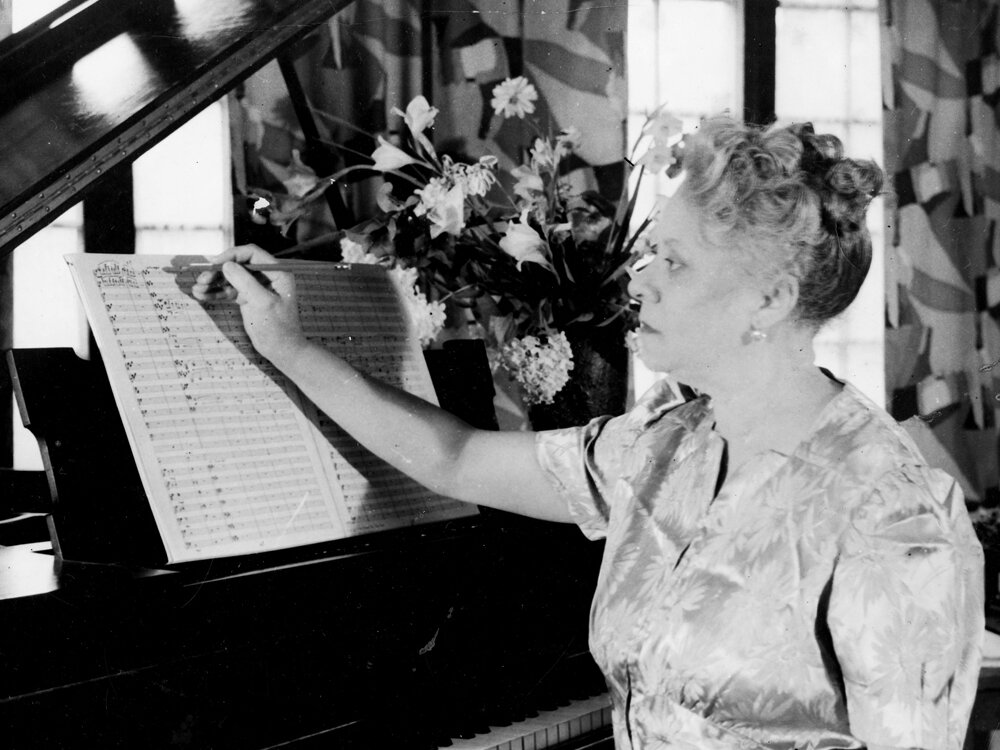
In 1933, the Chicago Symphony Orchestra gave the world premiere of Symphony No. 1 by a then little-known composer named Florence Price. The performance marked the first time a major orchestra played music by an African-American woman.
Price's First Symphony, along with her Fourth, has just been released on an album featuring the Fort Smith Symphony, conducted by John Jeter.
Fans of Price, especially in the African-American community, may argue that her music has never really been forgotten. But some of it has been lost. Not long ago, a couple bought a fixer-upper, south of Chicago, and discovered nearly 30 boxes of manuscripts and papers. Among the discoveries in what turned out to be Price's abandoned summer home was her Fourth Symphony, composed in 1945. This world-premiere recording is another new piece of the puzzle to understanding the life and music of Price, and a particular time in America's cultural history.
Price was born in 1887 in Little Rock, Ark. Her mother gave her music lessons since none of the leading white teachers in town would take her. In 1904, Price enrolled at the New England Conservatory in Boston, one of the few music schools to accept black students at the time. After earning two diplomas, she returned to Little Rock, where she taught, got married, and began raising a family. But racial tensions were on the rise, and a downtown public lynching in 1927 triggered a move to Chicago.
There, Price blossomed as a composer. Her First Symphony won a composing prize, which caught the attention of conductor Frederick Stock, who led the premiere of the piece with his Chicago Symphony Orchestra. The music is a blend of two traditions — African-American and European. The opening movement is reminiscent of Dvorak's "New World" Symphony, with its portentous sweep and lyrical melodies.
Price might be searching for her own voice in her First Symphony, but she adds distinctive touches. Cathedral chimes glisten in the serene slow movement, where a brass choir converses with delicate winds. In the third movement, African drums accompany a syncopated "Juba Dance," a folk tradition that originated in Angola and moved, with slaves, to American plantations.
Price and her music were well received in Chicago. The great contralto Marian Anderson closed her legendary 1939 Lincoln Memorial concert with a piece arranged by Price. Still, she scraped to make ends meet, writing pop tunes and accompanying silent films. In 1943, she sent a letter to Serge Koussevitzky, conductor of the Boston Symphony Orchestra, acknowledging what she was up against. "I have two handicaps," she wrote: "I am a woman and I have some Negro blood in my veins."
But Price pushed on. Two years later, she wrote her final symphony, the newly resurrected Fourth. In the opening movement, she quotes one of the most famous spirituals, "Wade in the Water." Price adds another "Juba Dance" for the third movement, and concludes with a bustling Scherzo that alternates serious and lighthearted episodes, ending with a bang.
Florence Price was celebrated in her day. But her untimely death in 1953, and the amount of music she composed but was never heard, helped dim her reputation over the years — until now. Tucked away in those 30 recently discovered boxes are some 200 compositions, which librarians and scholars are currently poring over. Clearly, Florence Price's story is far from over.
“If Viotti is the father of modern violin playing, surely Tartini is its godfather.”
Tartini was born in Pirano, a town on the peninsula of Istria, in the Republic of Venice (now in Slovenia) to Gianantonio – native of Florence – and Caterina Zangrando, a descendant of one of the oldest aristocratic Piranese families.
It appears Tartini's parents intended him to become a Franciscan friar and, in this way, he received basic musical training. He studied law at the University of Padua, where he became skilled at fencing.
A secret marriage to Elizabetta Premazore, the niece of the Bishop of Padua, in 1710 when he was 18 necessitated his flight from the city some three years later when the marriage was discovered. He eventually found refuge at Assisi where there was a friar at the monastery with some family connections to him. In Assisi, he began to study the violin with Father Boemo—who was most likely the Czech musician Bohuslav Cernohorsky—and played in the convent orchestra. Cernohorsky was later an organist at St. Anthony’s in Padua and Tartini’s colleague. After about two years in Assisi, Tartini was recognized by some visitors from Padua while performing (a curtain blew aside during a performance and revealed him, went the tale). His seriousness and musical ability led to the successful outcome of reconciliation with the Bishop, and he and his wife moved to Venice in approximately 1715 or 1716.
Tartini’s playing was said to be remarkable for its combination of technical and poetic qualities. He was regarded with universal pride by the inhabitants of Padua. He was serious, contemplative, of a scientific turn of mind, and was esteemed as a philosopher and a great musician. He was proclaimed by the Italians “il Maestro delle Nazioni,” the finest musician in the world, while the French termed him “le legislateur de l’archet,” the lawgiver of the bow.
Tartini was the first known owner of a violin made by Antonio Stradivari in 1715, which Tartini bestowed upon his student Salvini, who in turn gave it to the Polish composer and virtuoso violinist Karol Lipiński upon hearing him perform: the instrument is thus known as the Lipinski Stradivarius. Tartini also owned and played the Antonio Stradivarius violin ex-Vogelweith from 1711.
In 1726, Tartini started a violin school which attracted students from all over Europe. Gradually, Tartini became more interested in the theory of harmony and acoustics, and from 1750 to the end of his life he published various treatises.
Music can be medicine for your mind, with benefits from memory improvement to stress relief.
If you want to firm up your body, head to the gym. If you want to exercise your brain, listen to music.
“There are few things that stimulate the brain the way music does,” says one Johns Hopkins otolaryngologist. “If you want to keep your brain engaged throughout the aging process, listening to or playing music is a great tool. It provides a total brain workout.”
Research has shown that listening to music can reduce anxiety, blood pressure, and pain as well as improve sleep quality, mood, mental alertness, and memory.
Learn an Instrument
When 13 older adults took piano lessons, their attention, memory and problem-solving abilities improved, along with their moods and quality of life. You don’t have to become a pro, just take a few lessons.
The Brain-Music Connection
Experts are trying to understand how our brains can hear and play music. A stereo system puts out vibrations that travel through the air and somehow get inside the ear canal. These vibrations tickle the eardrum and are transmitted into an electrical signal that travels through the auditory nerve to the brain stem, where it is reassembled into something we perceive as music.
Johns Hopkins researchers have had dozens of jazz performers and rappers improvise music while lying down inside an fMRI (functional magnetic resonance imaging) machine to watch and see which areas of their brains light up.
“Music is structural, mathematical and architectural. It’s based on relationships between one note and the next. You may not be aware of it, but your brain has to do a lot of computing to make sense of it,” notes one otolaryngologist.
Everyday Brain Boosts from Music
The power of music isn’t limited to interesting research. Try these methods of bringing more music—and brain benefits—into your life.
Jump-start your creativity.
Listen to what your kids or grandkids listen to, experts suggest. Often we continue to listen to the same songs and genre of music that we did during our teens and 20s, and we generally avoid hearing anything that’s not from that era.
New music challenges the brain in a way that old music doesn’t. It might not feel pleasurable at first, but that unfamiliarity forces the brain to struggle to understand the new sound.
Recall a memory from long ago.
Reach for familiar music, especially if it stems from the same time period that you are trying to recall. Listening to the Beatles might bring you back to the first moment you laid eyes on your spouse, for instance.
Listen to your body.
Pay attention to how you react to different forms of music, and pick the kind that works for you. What helps one person concentrate might be distracting to someone else, and what helps one person unwind might make another person jumpy.
Pau Casals i Defilló was born 29 December 1876, usually known in English as Pablo Casals, was a cellist, composer, and conductor from Catalonia, Spain. He is generally regarded as the pre-eminent cellist of the first half of the 20th century, and one of the greatest cellists of all time. He made many recordings throughout his career, of solo, chamber, and orchestral music, also as conductor, but he is perhaps best remembered for the recordings of the Bach Cello Suites he made from 1936 to 1939. He was awarded the Presidential Medal of Freedom in 1963 by President John F. Kennedy (though the ceremony was presided over by Lyndon B. Johnson).
The man who would become the world's greatest cellist never heard one until age 11. By then he was an accomplished singer, pianist, violinist and (once his feet could reach the pedals) organist.
Three years earlier, when he had been enthralled by a street performer on a makeshift upright bass consisting of a bent broom handle with a single string, his father made him a crude replica from a gourd. (As a reminder of his humble origins, Casals kept it displayed in his home all his life). When Casals finally heard a cello in a trio visiting his remote Catalan village, its sound stirred him as human and profound.
Until then, the cello was deemed unsuitable for sensitive displays of emotion and was typically relegated to a role of accompaniment (as when chugging along with Baroque music). "Proper" technique of the time stemmed from strict training in which a student was made to hold a book under his bowing arm to restrict movement and to produce an unvarying tone. From his earliest lessons, Casals rebelled and resolved to liberate the cello from its chaste subordinate chore. Casals revolutionized bowing technique by using only portions rather than the entire expanse of the bow, lifting it from the strings and shading the tonal quality to emphasize the musical essence. He also pioneered percussive fingering (stopping the strings decisively rather than sliding the whole hand between notes),One of Casals' first Columbia 78s expressive intonation (varying the tuning according to harmonic demands), rhythmic vigor, varied attacks and decisive accentuation. His innovations bred interpretations having a compelling inner logic and an instinctive feeling for structure and meaning. Casals created a sense of style.
Throughout his career, Casals never forgot his roots and remained immersed in his deep abiding love of mankind. Rather than cater to the elite, Casals believed that the people who had produced a country's wealth should share its cultural riches. With his Barcelona orchestra, he launched wildly popular concert series to which only low-paid workers were eligible to subscribe (for six pesetas – about $1 – for an entire season) and insisted that their acclaim "meant more to me than any applause I had ever received."
German soldiers, taken to Japan as POWs during WWI, played Beethoven’s Ninth to pass the time — decades later, it’s become a beloved Japanese New Year tradition.
Since 1999, the Seattle Symphony has made a tradition of playing Beethoven’s Symphony No. 9 on New Year’s Eve. But a fondness for ringing in the new year with the Ninth began decades before that in an unexpected corner of the world: Japan.
Seattle Symphony principal trombonist Ko-ichiro Yamamoto recalls playing the Ninth nearly a dozen times in late 2003 while freelancing with Tokyo’s famed NHK Symphony, as well as another major Japanese orchestra.
A second-generation professional trombone player, Yamamoto said his father, Tatsuo, recalled performing the Ninth with the Japan Philharmonic Orchestra on more than one occasion. “I’m sure that right now,” Yamamoto said, “some orchestra is playing Beethoven’s Ninth in Tokyo.”
In Japan, the German composer’s last symphony is nicknamed “Daiku” or “Big Nine.” According to The Japan Times, in December of 2009 there were 55 performances of the Ninth in Tokyo; on some occasions, the chorus has ranged from 6,000 to 10,000 voices for the famed “Ode to Joy” in the final movement. “Daiku” is the last scheduled performance for three of Tokyo’s most prestigious orchestras this year.
Japan wasn’t introduced to Western classical music until the late 19th century but didn’t waste time catching up — Tokyo, Japan’s largest city, has more professional symphonies than Berlin. But how did Beethoven’s Ninth become a national favorite?
In 1914, a colony of German soldiers living in Tsingtao, a city on the eastern shore of China, was captured by Japanese soldiers. World War I had erupted and Japan sided with Great Britain and the rest of the Allies. At the time, Tsingtao was a major German military base and Japan demanded its surrender. When Germany refused, Japan invaded and detained almost 4,000 soldiers as prisoners of war.
About 1,000 of those German soldiers were sent to Bando, a POW camp in Naruto, located in Japan’s Tokushima Prefecture. The soldiers occupied their time in a variety of ways, from printing a camp newspaper to supervised jaunts to local sights, as well as forming an orchestra.
The Ninth was a favorite among the POWs and the so-called “Bando orchestra” performed the piece inside the camp on a makeshift stage. After the war ended, the former POWs performed the Ninth outside Bando’s walls for an audience in Naruto; in 1927, the piece was performed in its entirety by the Shin Kokyo Gakudan (or New Symphony Orchestra), now known as the NHK Symphony Orchestra.
The Ninth continued to grow in popularity. On Dec. 31, 1940, a Polish conductor led a Japanese ensemble in a live radio performance of the Ninth to commemorate the creation of Japan. By the 1960s, the Ninth sold out concert halls across Japan as more musicians and choristers tried to tackle the difficult notes and German lyrics.
Using verse from a popular German poem titled “Ode to Joy,” Beethoven completed the Ninth in 1824. At its premiere in Vienna that same year, the composer’s health was worsening by the day — most scholars agree he was suffering from cirrhosis of the liver — and he was almost completely deaf. A performer onstage had to turn Beethoven around to see the standing ovation from the crowd.
Simon Woods, president of the Seattle Symphony, said the composition is especially fitting for the end of the year with its broody, dark first movement and its exuberant finale.
“I think the journey that the piece is on, from the first movement to the last movement, is a symbolic journey,” Woods said. “I think that’s why it often plays a transitional role. It carries you through.”
Classical music can be a wonderful thing to experience, with its varying moods and tones, and science actually shows us that classical music in particular can have the power to improve our health. Here are five ways you might benefit from listening to classical music. 1. Classical Music Might Lower Our Blood Pressure
Researchers from the University of Oxford presented findings at the British Cardiovascular Society Conference in Manchester recently that certain genres of music appear to lower blood pressure. The researchers believe that the key may be the 10-second repeated rhythm that is found in many classical works such as Va Pensiero, Nessun Dorma, and Beethoven’s 9th Symphony. Classical music that had a faster rhythm, such as Verdi’s Four Seasons, did not produce this effect.
The researchers caution that their findings need more extensive testing, but this may be the underlying reason why classical music has been shown to have various other benefits, and so has been greeted with cautious optimism by other researchers.
2. Can’t Sleep? Try Some Sebelius
Research has shown that stress-related insomnia can be tough to beat if we don’t resort to medication, however controlled studies have shown that students who listen to classical music tend to sleep better and sometimes for longer (in terms of unbroken sleep) than those who listen to things like audiobooks or nothing at all. It’s unlikely that classical music alone will cure a chronic case of insomnia, but it might be that if you’re just having a rough patch, classical music could form part of an improved sleep routine.
3. Classical Music May Help Calm Your Road Rage (But There’s a Catch)
Due to the fact that classical music is calming, some therapists have recommended classical music as part of a stress reduction program for people who experience what’s often termed “road rage.” Interestingly, a recent study actually showed that music by popstars like Adele might offer even more of a calming effect, and other studies show that soft-rock may have a similar impact.
However, being too relaxed on the road can be a bad thing. One study has shown that classical music might actually be too soothing and could put the average driver in danger of becoming complacent, so if you do listen to classical music while driving, try to go for lively pieces that will keep you engaged.
4. Classical Music Won’t Improve Your Memory But it Could Help You Study Better
The idea that listening to certain kinds of music can help improve your memory or even raise your intelligence has actually been disproved. Researchers have repeatedly tested the so-called Mozart effect, and found that it doesn’t hold true–or, at least, not in the way that we traditionally perceive improved brain performance. However, what the research does show is that well-chosen background music can help to make for a better study experience which in turn might lead to better fact retention and cognitive performance. It doesn’t have to be Mozart or even classical music though, as genres like soft jazz and other mostly instrumental music with a gentle tempo tend to aid concentration. 5. Classical Music May Help Boost Your Mood
It’s not going to be a substitute for medical help if you have a mental health condition, but incorporating music as part of your own wellness strategy might be a good idea. Some studies have shown that classical music and other, so called softer music, might be good for helping to ease depressive states. The reason why that might be isn’t fully understood, but some researchers think it’s because it helps us to regulate our breathing better and generally relaxes us in ways that other interventions can’t. As above, classical music also improves sleep quality, and this in turn is a known benefit for combating mood disorders. Other studies have shown that music in general helps to elevate our moods.
This is not to say that other musical genres don’t have their worth. In fact, science shows that rap music and heavy rock may be particularly good if you are working out because its tempo can help you keep your heart rate up which, if safely managed, can ensure you’re getting the maximum benefits from a fat burning workout.
The Memorial Day holiday is a time for quiet reflection in
remembrance of those who have given their lives to protect American
ideals of freedom and justice. Each of these five classical works are inspired by the
sacrifices made by Americans throughout history:
1. Charles Ives – Variations on “America”
Using the theme from the early American anthem, “My Country, ‘Tis of Thee,” Ives composed Variations on “America” in
1891 when he was only 17 years old. As the son of a Civil War era U.S.
Army bandleader, Ives was well-versed in the patriotic music of the day,
and it is likely that that early influence inspired him to write this
work. Originally scored for organ, it remained unpublished for over 50
years, when it was rediscovered and finally published by renowned
organist E. Power Biggs. The work remains to this day a satisfying piece
of patriotic music from one of America’s finest composers.
2. Aaron Copland – Fanfare for the Common Man
Written in direct response to America’s entry into World War II, Fanfare for the Common Man reflects
on America’s growing role on the world stage. Rather than simply
writing “a fanfare for soldiers,” as was requested by conductor Eugene
Goossens who commissioned the piece, Copland drew inspiration from the
then-vice president Henry A. Wallace’s speech, “Century for the Common
Man,” where he proclaimed that individual rights and freedoms were
essential components of democracy. In writing his Fanfare for the Common Man,
Copland commemorated the great sacrifice American men and women made in
World War II while celebrating the freedom that makes American ideals
worth fighting for.
3. Britten – War Requiem
Britten’s War Requiem is
a non-liturgical Requiem mass that uses text from the traditional Latin
Mass for the Dead along with nine poems on war by English poet Wilfred
Owen. The work for combined choir, organ, and double-orchestra is
dedicated to several of Britten’s friends who lost their lives in the
course of World War II, and was commissioned for the consecration of the
new Coventry Cathedral, which was rebuilt after the original was
destroyed in a WWII bombing raid. Although not written by an American
composer, Britten’s War Requiem commemorates those who gave their lives fighting in World War II, making it a work suited for Memorial Day listening.
4. John Adams – The Wound Dresser
No conflict has been more deadly to
American lives than our own Civil War, a tragedy which has inspired many
artists to meditate on the absurdity of war and the futile loss of life
it causes; John Adams’ The Wound Dresser is
one such piece. Using excerpts from Walt Whitman’s poem of the same
name, Adams composed a work for baritone soloist and chamber orchestra
telling the story of Whitman’s time working as a Civil War hospital
attendant and looking unflinchingly at the brutality of America’s
bloodiest conflict. Though Whitman’s poem was written over 150 years
ago, his words, along with Adams’ music, continue to resonate in the
modern day, making this piece well worth a listen.
5. Hindemith – When Lilacs Last in the Dooryard Bloom’d: A Requiem for those we love
You might not expect the most
significant classical work for Memorial Day to be written by a German
composer, but that’s exactly what Hindemith accomplished with When Lilacs Last in the Dooryard Bloom’d: A Requiem for those we love.
Hindemith, who emigrated to America in 1940, drew on Walt Whitman’s
poem of the same name for the work, which was commissioned by conductor
Robert Shaw after the death of president Franklin D. Roosevelt. The
original poem was written in mourning of Abraham Lincoln, making
Hindemith’s Requiem a powerful memorial to the leaders who represented the pinnacle of American values of liberty and equality.