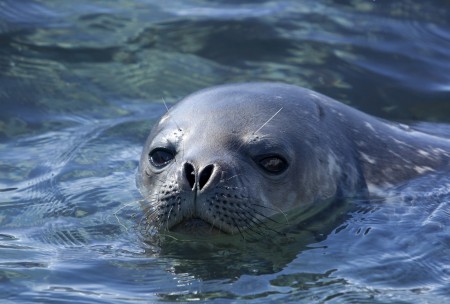
Invented by Belgian instrument maker Adolphe Sax, the saxophone has been wooing people since 1846 with it’s bluesy serenades. Most recently, seals – namely Casey the seal – has been the recipient of such beautiful sonnets ts the Taronga zoo in Australia, as they have started using the Belgian Saxophone as a tool in their new ‘environmental enrichment’ program.
The leopard seal named Casey has been loving his new program and even singing along as Steve Westnedge the elephant keeper (and apparently seal-keeper) has been taking time to play for Casey each day. The Australian Marine Mammal Research Centre (AMMRC), based at Taronga Zoo, has been watching and studying Casey since he was rescued near Sydney in 2005. Marine mammals supervisor Ryan Tate comments on the program:
“They are certainly aware of new noises, so something like the saxophone was a great way of giving our leopard seal some different environmental enrichment. At certain times of year they really react to the noises and sing back.”
Leopard seals are known for their highly complex sound vocabulary. The fact that this seal and those working at the Taronga zoo are having this experience, is unique for sure. Casey is the only leopard seal in the whole world who is living in a zoo. Most leopard seals reside in the ices of Antarctica, occasionally visiting New Zealand, Aukland and the Campbell islands during the deep winter months. “Underwater vocalizations are of low to medium frequency and long duration. The leopard seal’s lowest frequency call is particularly powerful and can be heard at the surface and felt through the ice.” It seems Casey the seal is liking the deep notes of the saxophone as you watch him dancing and twirling near the glass.
Music played for zoo animals seems like a great idea indeed, especially in light of the fact that these creatures are not in their natural habitats and have to adapt to an environment unlike ‘home.’ Music has been shown to decrease stress in humans, so why not animal life in general? Sound therapy has long been recognized as not only a way to calm the mind and soothe the emotions, but to balance the brain and release healing hormones in the body as well. Animals who have been captured and put into zoos because of injuries like Casey, could greatly benefit and find intense healing from sound therapy, thus allowing their gentle release back into the wild.
Originating in Belgium as a bridge-instrument to “be the most powerful and vocal of the woodwinds, and the most adaptive of the brass—that would fill the vacant middle ground between the two sections” is today, being used as a zoo tool to soothe Casey the seal in Australia. Do you think Adolphe Sax would have ever imagined it? Perhaps more zoos will begin to incorporate music and extend the environmental enrichment program to animals of every species in every zoo. It certainly sounds like a great plan for aspiring musicians – to play for the animals before the people ‘devour them.’
Conrad Tao is a 19-year-old virtuoso who tries to push the limits of classical music by combining tradition and technology. His experiments include compositions for piano and iPad as well as stage performances with a bright pink toy piano.
Tao, a New Yorker, began playing children's songs on the piano at just 18 months of age. He gave his first recital age four. He has won several awards, including the Avery Fisher Career Grant, a Gilmore Young Artist Award and eight consecutive Ascap Morton Gould Young Composer Awards.
He believes that classical music needs more than a marketing effort to attract a younger audience. It must "confront contemporary reality", he says.
Live in concert in the WGBH Fraser Performance Studio, violinist Daniel Stepner and violist Anne Black get a once-in-a-lifetime opportunity to perform a work by Mozart on instruments that the composer himself owned and played.
Mozart never made it to America: getting seasick crossing the English Channel put an end to any of his seafaring fantasies. But America was frequently on Mozart's mind. In fact, his closest collaborator, librettist Lorenzo Da Ponte, actually immigrated to these shores and became the first professor of Italian at Columbia University in New York.
Mozart's music has made it here, of course – it's woven into the lives of practically everyone. And that's a big part of why there were so many goosebumps when an excited audience in Boston was suddenly in the presence of two of the instruments that Mozart had placed firmly under his chin, in private and in concert, uncountable times.
Only a few days earlier, an Austrian had made his way through security with a violin case and boarded a plane in Salzburg. Another Austrian boarded a different plane with a viola case. And that marked the first time that two priceless possessions of Mozart had gone transatlantic. What a thrill that they were headed for the room up the hall from us at Classical New England. The Salzburg Mozarteum Foundation was reaching out to the wider world, and the two instruments were never, ever out of the sight of at least one member of the entourage who came along for events presented by the Boston Early Music Festival.
Ulrich Leisinger and Gabriele Ramsauer of the Mozarteum Foundation painted a vivid picture of Mozart the performer – playful, proud, very short (just five feet!) and ultimately favoring the viola over the violin. I watched Daniel Stepner taking advantage of every minute that he had with the violin, trying to unlock the secret of making it speak. It's no turbo-charged Stradivarius – it has a bright but intimate sound that will complain if it's leaned on too heavily. Dan had to learn its ins and outs in a matter of hours. The marvel is that the violin has remained almost entirely intact – just as Mozart knew it. And that's because everyone who owned it knew that it had been Mozart's. The viola is a beauty, too, although it has seen a number of alterations over the years.
I squinted at the instruments during the performance, trying to imagine them in Mozart's candlelit rooms. I fantasized about their warm color getting a glint of sunshine through a Paris window during a rehearsal for the premiere of one of the violin concertos. I wondered if Mozart improvised cadenzas on that violin.
I asked Leisinger if we had any way of knowing what Mozart's actual voice sounded like. He said that we only know that when he sang he was a tenor. So his speaking voice was probably high. That's something we'll never be able to hear. But it was so good to hear the voices that came from his instruments. And because Mozart really is so deeply woven into us, virtually everyone took a moment at the reception to have their photo taken holding Mozart's violin. Having played so much Mozart at the piano over the years, I felt so deeply happy and privileged to touch these things that meant so much to him.
There are few things as annoying as being stuck on a tarmac — in a cramped, packed plane — for long periods of time. But when you have some of the members of the Philadelphia Orchestra on your flight, it could turn magical.
No, seriously.
It happened to passengers on a flight from Beijing to Macau, this week. They had been sitting on the tarmac for three hours when a quartet of musicians from the Philadelphia Orchestra pulled out their instruments and provided a "Pop Up" performance.
The orchestra published video of the performance:
.