The Composer and his Muse: Franz Schubert and Therese Grob


Therese Grob was the first love of the composer Franz Schubert.


Nothing stokes the fire of adolescence and the enormous physical and psychological changes that occur during the teenage years quite like the teenage girl and/or boy next door. Franz Schubert spent his formative years in Lichtental, the ninth district in Vienna, and the girl next door was Therese Grob. She was 18 and Schubert only a year older. Her parents owned a small silk factory not far from the Schubert household, and young Franz was a frequent visitor to the house. Therese was described by one of the first Schubert biographers as “by no means a beauty, but well-built, rather plump and with a fresh, childlike round face and a lovely soprano voice.” There can be no doubt that Schubert was infatuated with Therese, and the composer’s friend Anselm Hüttenbrenner recalled a conversation in which Schubert had said, “I loved someone very dearly and she loved me too. For three years she hoped I would marry her; but I could not find a position which would have provided for us both.”

Therese  had a beautiful soprano voice. Schubert’s first complete Mass setting was composed entirely with Therese in mind, and she sang the soprano solo at the premiere of the Mass in F, D. 105 at the Lichtental parish church, while Schubert conducted the performance.


In addition, Schubert compiled 17 songs at various times during 1816, which subsequently became known as the “Therese Grob Album.” The term “album” is somewhat misleading, as the collection does not describe the chronological order of composition. Therese later told Schubert’s first biographer, that “Süsse, heilige Natur,” (An die Natur), which appears as the third song in the collection, was the first song she ever saw.


Three of the songs were expressly written for Therese, as no other manuscript copies exist. The remaining 14 are copies that Schubert made for Therese; however, he also made copies for his other friends.

Therese later suggested that she had no idea that Schubert was in love with her, and she married the master baker Johann Bergmann at the Lichtental church in 1820. Schubert also composed music for Therese’s brother Heinrich, two years his junior. Heinrich was a talented pianist and violinist, and the violin sonatas op. 137, published posthumously, were almost certainly composed for Heinrich Grob.


Read more

Dr. Warren Woodruff & Angelica Hale featured on ATl & Co.'s Proud Parent Show!

Dr. Warren Woodruff with a performance from singing America's Got Talent sensation 9-year-old Angelica Hale on Proud Parent with Christine Pullara Newton!

Angelica sang "The Hills are Alive" from the Sound of Music to the piano accompaniment by Dr. Warren Woodruff.


Performance produced and directed by Lynn Stallings Of the Atlanta Workshop Players and Dr. Warren Woodruff, inspired by Dr. Fuddle and The Gold Baton.


Maria Callas, The Divine Voice Of Classical Music

Maria Callas: vocal chameleon, gossip-column staple and influential opera icon.
Weston/Getty Images

No opera star has shone brighter in the public consciousness of the last half-century than soprano Maria Callas. Born in New York in 1923 to a couple of struggling immigrants who had just arrived from Greece a few months before her birth, Callas — who throughout her life bore an undeniable feeling for music, a pronounced taste for luxury, and an iron will — climbed to the pinnacle of international fame.

Much of that notoriety had nothing to do with her artistic life. Her long affair with the world's then-wealthiest man, Aristotle Onassis — and his eventual marriage to Jacqueline Kennedy instead of to her — guaranteed that she was a gossip-column staple. Her epic battles with other singers and opera impresarios made for prime publicity fodder, too, and included a feud with the Metropolitan Opera's then-general manager, Rudolf Bing, that left her barred from the Met, and an episode in which she was served a lawsuit backstage in Chicago that became the catalyst for an iconic photo of a furious Callas.


But all of that was surface noise. Long after the newspaper headlines have faded away, her art remains. None of the high-society chatter, nor her high fashion sense, nor the contours of her deeply unhappy personal life, nor her mercurial personality was what made Callas La Divina, "The Divine One." Onstage, she possessed one of the greatest voices of all time. She was an indelible presence whose artistry made her the icon and envy of performers across many genres. (From its inception, "Turning the Tables" — a readdressing of the pop music canon — was not meant to include classical musicians. But such an accounting is long overdue in its own right, particularly considering the extent to which female classical artists are still so routinely denigrated, slighted, dismissed or rendered invisible.)

Vocally, Callas was a chameleon. At the beginning of her career, her richly textured voice was deemed right for weighty, dark-hued Wagner, but she could also dispatch fizzy, frilly roulades in Rossini's Barber of Seville, and take her listeners to the stratosphere in Verdi's Aida.


Although she never sang the role on stage, her recordings as the coy, sexually irrepressible lead in Bizet's Carmen set a standard — as she also did in another, far different signature role when she played the tormented high priestess and mother of two in Bellini's Norma.


Her dedication to the bel canto operas of composers like Bellini and Donizetti also paved a career path way for singers, including the likes of Beverly Sills and Marilyn Horne, to excel in that formerly neglected repertoire. A nickname like "The Divine One" might imply that Callas possessed a voice that was ethereal and sweet, perhaps more like that of a choirboy than of a grown woman, and certainly a technically perfect one. That was not Callas at all. What made Maria Callas La Divina is how she fought, every step of the way.


"Mine is a big destiny," she once told an interviewer. Her divinity was like that of a classical Greek goddess: rife with insecurities, trauma, jealousy and outsized aspirations. And like the deities of myth, she didn't always win her battles. Callas' performances were a high-wire act: Either she thrilled audiences or exasperated them, with little middle ground. She was no stranger to hearing boos, or to having vegetables thrown at her. And she stood on even less sure technical terrain as her voice declined fast and early — while she was still in her forties — before her untimely death at age 53.

But the ultimate goal of Callas' performances was not obtaining plush vocal perfection or a simpering prettiness: it was glory. That singular voice was a penetrating, ferocious weapon that she wielded to extract maximum emotional truth from the roles she played, no matter what the cost. She shaped words and lines with great care, lending dramatic form and heft to even the silliest operatic frippery. She expected her audience to listen with as much intelligence and focus as she put out. Callas was a compelling, magnetic, fiery, impassioned presence — and she gave her characters immortality.

Read more


PLAY ALONG and VOTE for Our Favorite Angelica Hale on America's Got Talent Beginning August 15th!!

The live shows are here for America’s Got Talent 2017, which means that audience and viewer participation is key in keeping your favorite acts in the competition. If you want our favorite Angelica Hale to stay on the show, then you need to vote on line!

OR...

NBC has officially launched its new AGT App, which is available via Google Play and the Apple Store. With the app, you can vote along with the show and even customize your buzzer sounds with voices from the judges. Viewers who use the app can actually see real-time results totaled from the at-home voting activity.

Season 12 premiered to the highest viewership in six years and continues to be the No. 1 show of the summer. Many of this season's acts have already surpassed 100 million views on their audition videos and the numbers continue to grow.

Our favorite, Angelica Hale, is a young singer from Atlanta. At just two years old, Hale started singing along to songs on the radio, and began taking professional vocal lessons at the age of five. When she was four years old, Hale developed a severe bacterial pneumonia that nearly took her life, causing her to go septic and have multiple organ failures, including kidney failure and permanent scarring in her right lung. She remained in kidney failure for more than a year, but in 2013 received a life-saving kidney transplant from her mother. Today Hale performs at events and fundraisers all around the country in support of Children's Miracle Network Hospitals and Children's Healthcare of Atlanta, which is the hospital that saved her life.


Possessed or Blessed

Niccolo Paganini, who is considered the greatest violin virtuoso of all time, was probably one of the most erratic figures of all time. Through his numerous performances all over Europe, he enthralled and inspired every audience, including musicians of his era.

Niccolò Paganini (1819), by Ingres


 Listen to Joshua Bell and Sharon Isbin perform Paganini's Cantabile at the White House Evening of Classical Music on 4 November 2009.


Hector Berlioz
Franz Schubert was mystified by him, Rossini was appalled by him, and Meyerbeer followed him from one concert to another not being able to get enough of his playing. Berlioz has described Paganini as "one of those artists of whom it must be said: 'They are because they are and not because others were before them'." In Paris, Liszt came under Paganini's spell and was so stimulated by his fabulous technical virtuosity, determined to accomplish similar miracles with the piano, and pushed his technique to the highest limits.

Paganini was considered a genius, a god, a devil worshiper, anything but that of reality. There was a rumor, for instance, that when Niccolo was only six, his mother made a pact with the Devil and is said to have traded his soul for a career as the greatest violinist in the world.

Paganini was a legend. In fact, he was so amazing no audience could succumb to any type of disturbance during the trance he created through his musical renditions. After borrowing a Guarnerius violin for a single concert, the lender begged him to keep it for fear of coming under Paganini's supernatural powers. He also won a Stradivarius violin in a similar manner by playing a technical piece by sight which was insisted that nobody could perform even after preparation.


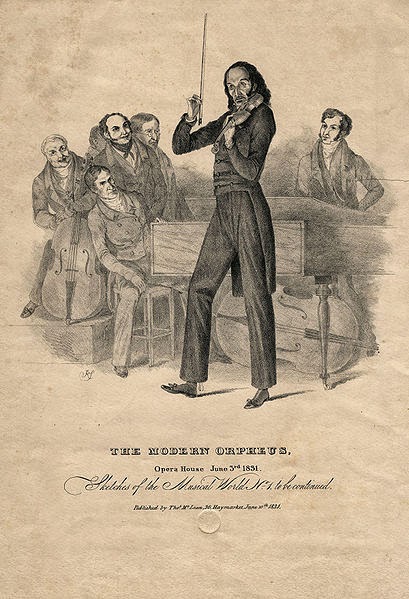
1831 bulletin advertising a performance of Paganini
Besides his superb technical ability, his cadaverous appearance led to myths of all sorts. He was tall and thin, had a long nose, a pale and long-drawn face with hollow cheeks, thin lips that seemed to curl into a sardonic smile, and piercing eyes like flaming coals. The rumor was spread that he was the son of the Devil. It was difficult to think much otherwise as Paganini dressed in black, played weaving and flailing, with skinny fingers cavorting over the strings, and contorted shoulders giving him the appearance of a giant flapping bat. Paganini's every movement and every tone emanating from his violin seemed to support the 300-year-old myth that the violin was the "Devil's consort" and that the violinist himself was the Devil. Some people, when in his presence, would actually make the sign of the cross to rid themselves of what they believed were his evil powers. He was once forced to publish letters from his mother to prove he had human parents.

Whenever and wherever he played, he aroused tenor and awe in his audiences. There was the rumor that a satanic figure, a double of Paganini, always appeared in the audience in sombre black with the same long black locks, burning eyes, and sardonic smile. Or else the figure appeared on the stage at Paganini's side dressed in a red cloak and pantaloons, with horns, hooves, and a tail to guide Paganini's bow arm through a performance. It was believed that this figure raised a thunderstorm, during a concert and conducted lightening to the free end of the bow, and at another performance he actually took possession of Paganini's body. In spite of his appearance and the suspicions, however, he was worshiped wherever he went.

All parts of Europe were delighted with his music and women were spellbound at the sound of his hypnotic melodies. There was another rumor that he was the greatest womanizer of all time and that he killed a woman, imprisoned her soul in his violin, and used parts of her intestines as an eternal source of gut for his strings. The unearthly screams of women were sometimes heard coming from his violin as he played on stage.

Paganini was born of a poor family in 1782 at Genoa and showed a natural talent at a very early age. His father wanted his son to be a genius and did everything in his power to make that come true. He stood by him consistently when he practiced disciplining him severely with a rod that was seldom spared. His father was quite successful in his persistence for at the age of eight, he played a Pie yel Concerto in a Genoa church. He so enthralled the audience, that his playing became in great demand for local social gatherings. His teachers at that time were Giovanni Servetto and Giacomo Costa. When he turned nine, he made an official debut in a Genoa concert auditorium playing his own composition, La Carmagnole which is a theme and variations. By age thirteen, he was known throughout the town as the "wonderchild."

He continued with his studies in Leghorn with Ferdinando Paer and in Parma with Alessandro Rolla, which began his first extended concert tour. He succeeded rapidly in the cities of Lombardy playing many of his own electrifying compositions.

At the age of seventeen, he was on his own. He no longer needed financial assistance from his father and broke away assured of his talent. Freed for the first time of his father's strictness, he gave in to his two passions - women and gambling -- to which he was thenceforth to be addicted.

At the turn of the century, he disappeared from the public eye. It is generally believed that he fell in love with a Guscan noble lady and lived with her at her chateau. At this time, he abandoned the violin temporarily because of his mistress' wishes and concentrated his virtuoso and creative gifts on the guitar. He also composed several pieces and chamber works for the guitar. But, after three years, he returned to his native city to study, play, and compose at full intensity.

The most amazing stories were heard about his performances. The most famous is of the concert in Leghorn. When a string of his violin snapped in an intricate passage, the audience began expressing derision. But when Paganini continued to play the piece on three strings instead of four, the derision turned to wonder and awe. From then on Paganini would not hesitate to use this devise on purpose to further entrance his audience. Often he would use worn strings so that he could complete his performance on three or even two strings when they snapped. Later he got the idea to write entire pieces for a single string, such as the Fantasia on the G String.

By 1813, Paganini became the greatest violinist of his day and the most worshiped. He spent the next decade and a half performing numerous concerts throughout Italy. His health, however, was turning bad which limited his touring voyages to his own country. When he finally left his country to perform in other parts of Europe, the concert halls were filled immediately and crowds rushed to see for themselves the creature that was so talked about. In 1828, he was in Vienna where he hypnotized his audience. Everyone was talking about him. Snacks and billiard shots were named after him.

After Vienna, he traveled extensively throughout Germany and in 1831, he arrived in Paris, his ultimate goal. In Paris, there was a study made of him because his unusual appearance created an abnormal "presence" about him. Up until then there was no challenge as to the idea that he was possessed by the devil or was some sort of god himself. Through this study, however, it was found that his physical characteristics were linked to his mental abilities; the same qualities which characterize a genius.

In his tour to England and Scotland, Paganini made the largest sum of money that any performing artist had earned up to that time in a single trip.

He returned to Italy and purchased an estate near Parma where he made several concert appearances despite his suffering from poor health. He lost some of his fortune in a gambling house named after him, thus making him restless and weary. He started coughing and eventually lost his voice completely in 1838. He went to Nice for a rest cure - but neither rested nor was cured. He spent his last hours improvising feverishly on his violin, defying his rapidly waning strength. Finally, he died on May 27, 1840.


Paganini on his death bed

For five years the Church, disturbed as to his orthodoxy, refused his body interment in consecrated ground, and so it was laid to rest in a village graveyard on his own estate. The people in nearby towns use to say that every night they heard the sounds of a ghostly violin emanating from that coffin. The legend of Paganini's life lasted until the very end.

   
Reposted From Guitarra Magazine


The Story Behind Beethoven’s Rage Over A Lost Penny

Beethoven’s rage was as famous as his cantankerous household habits.

He moved dozens of times, often the result of a dispute with the landlord.

Once Beethoven cut a hole in the wall of his RENTAL apartment, because he thought there was a fine view of the Cathedral that he was missing.

His landlord was a little perturbed, having not been told of Beethoven’s whimsical alterations.

Beethoven’s reaction was to get mad at the landlord, and immediately move to another apartment, leaving the huge hole in wall.

Beethoven was also known to play the piano loudly, and many complaints were registered by neighbors about the great composer’s strange hours.

He was famous for his disputes with his housekeepers, and had trouble finding anyone who would work in a household in such constant turmoil.

There were complaints by neighbors of loud crashing noises as Beethoven threw plates and books at the maids he had hired to serve him.

Beethoven often accused the maids of stealing coins from him.

And the Maestro’s dining habits left much to be desired.

One housekeeper would bring him a tray of food only to find that it was untouched weeks later. Uneaten trays of food piled up in the corner, right next to stacks of scores of the great genius’s symphonies.

But Beethoven was more likely to eat at the neighborhood pub than his lonely apartments.

He was a fixture at the local bar and would drink red wine in his private booth.

At one point Beethoven was composing his famed RONDO CAPRICCIO, a booming and boisterous piece that exuded energy and vitality.

One night a neighbor heard a loud dispute.

Beethoven was in a rage, accusing a maid of stealing a gold penny, and he was screaming. The maid ran out, never to be heard from again.

The neighbor then heard furniture crashing, and he could only conclude that the great Maestro was tipping over furniture, madly looking for the lost gold penny.

The story spread through the neighborhood, and became part of the legend of Beethoven’s bad moods and curmudgeonly behavior.

But more remarkable is the fact that the piece Beethoven was composing at the time of this story, the RONDO CAPRICCIO, became nicknamed the RAGE OVER A LOST PENNY for its rollicking, pounding enthusiasm.


It remains one of Beethoven’s most cherished masterpieces.


Read more