The Composer and His Muse: Harriet Smithson and Hector Berlioz


In 1827, Berlioz attended a performance of Shakespeare’s Hamlet given by a troupe of British actors at the Odéon Theatre in Paris. There, the 24-year-old composer became infatuated with the Ophelia of the production, an Irishwoman named Harriet Smithson. 

The composer had to find an outlet for his obsessive love – naturally, that was music. He formed the idea of a “fantastic symphony” portraying an episode in the life of an artist who is constantly haunted by the vision of the perfect, unattainable woman.  


In Symphonie fantastique Berlioz imagines himself, the lovelorn artist, attempting suicide by opium poisoning. He doesn’t administer a lethal dose as intended, but instead succumbs to a deranged, drug-fueled dream in which he has killed his beloved and faces execution for the crime.
Marie Moke

By now recoiling from his obsession with Smithson, Berlioz fell in love with a nineteen-year-old pianist, Marie ("Camille") Moke. His feelings were reciprocated, and the couple planned to be married. In December Berlioz organised a concert at which the Symphonie fantastique was premiered. Protracted applause followed the performance, and the press reviews expressed both the shock and the pleasure the work had given. Berlioz's biographer David Cairns calls the concert a landmark not only in the composer's career but in the evolution of the modern orchestra. Franz Liszt was among those attending the concert; this was the beginning of a long friendship. Liszt later transcribed the entire Symphonie fantastique for piano to enable more people to hear it.


Shortly after the concert Berlioz set off for Italy: under the terms of the Prix de Rome, winners studied for two years at the Villa Medici, the French Academy in Rome. Within three weeks of his arrival he went absent without leave: he had learnt that Marie had broken off their engagement and was to marry an older and richer suitor, Camille Pleyel, the heir to the Pleyel piano manufacturing company. Berlioz made an elaborate plan to kill them both (and her mother, known to him as "l'hippopotame"), and acquired poisons, pistols and a disguise for the purpose. But by the time he reached Nice on his journey to Paris he thought better of the scheme, abandoned the idea of revenge, and successfully sought permission to return to the Villa Medici. He stayed for a few weeks in Nice and wrote his King Lear overture.


Symphonie Fantastique was premiered in 1830 but Smithson did not hear the work until 1832, when she realised she might be the inspiration for it. Intrigued, she agreed to meet the composer and was blown away by the force of his emotion.

Despite neither speaking the other’s language, Harriet and Hector married on October 3, 1833. Happy ever after? Sadly, no – the obsession faded and they divorced seven years later.  Symphonie Fantastique has an enduring popularity and gives us a musical memoir of Berlioz’s infatuation with Smithson. 'Love cannot express the idea of music, while music may give an idea of love,' wrote the composer.


Sources: Limelight Magazine
Classic FM
Classic Music.com
Wikipedia


Pianist Alexander Melnikov on Playing Historic Instruments


The Russian pianist Alexander Melnikov has made several recordings using period instruments, and his latest disc features music by Schubert, Chopin, Liszt and Stravinsky on instruments from the 1830 and 1875, and a modern concert Steinway (he has also performed this programme on similar instruments), offering listeners and audiences the chance to experience four great works of the piano repertoire interpreted in their original instrumental environment. It’s a fascinating exploration of familiar repertoire through the medium of different pianos and how the composers responded to them. Meanwhile, the organisers of the International Chopin Competition have launched a new competition in which participants will perform on period instruments. The inaugural competition takes place in September this year and I sincerely hope this competition will offer competitors and audiences something more than a novelty or “living museum recital” and will cultivate sensitivities and sensibilities in pianists, who can appreciate and respond to what period pianos provide.

Albert Einstein: The Violinist


Einstein's mother, Pauline, was an accomplished pianist and wanted her son to love music too, so she started him on violin lessons when he was six years old. Unfortunately, at first, Einstein hated playing the violin. He would much rather build houses of cards, which he was really good at (he once built one 14 stories high!), or do just about anything else. When Einstein was 13-years old, he suddenly changed his mind about the violin when he heard the music of Mozart. With a new passion for playing, Einstein continued to play the violin until the last few years of his life. For nearly seven decades, Einstein would not only use the violin to relax when he became stuck in his thinking process, he would play socially at local recitals or join in impromptu groups such as Christmas carolers who stopped at his home.

Music for fun and physics

Einstein with Bronislaw Huberman
Music was not only a relaxation to Einstein, it also helped him in his work. His second wife, Elsa, gives a rare glimpse of their home life in Berlin. “As a little girl, I fell in love with Albert because he played Mozart so beautifully on the violin,” she once wrote. “He also plays the piano. Music helps him when he is thinking about his theories. He goes to his study, comes back, strikes a few chords on the piano, jots something down, returns to his study.”

In later life, his fame as a physicist often led to invitations to perform at benefit concerts, which he generally accepted eagerly. At one such event, a critic – unaware of Einstein’s real claim to fame as a physicist – wrote, “Einstein plays excellently. However,his world-wide fame is undeserved. There are many violinists who are just as good”.

One wag, on leaving another concert in which Einstein had played, commented, “I suppose now [the Austrian violinist] Fritz Kreisler is going to start giving physics lectures”.

There are nevertheless conflicting accounts of his musical abilities. Probably the least generous come from great artists, of whom Einstein counted many as personal friends as well as chamber-music partners. These included the pianist Artur Rubinstein, the cellist Gregor Piatigorski, and Bronislaw Huberman, one of the most remarkable and idiosyncratic violin virtuosos of the 20th century.

In 1936 Huberman visited Einstein in Princeton to discuss his plans to found the orchestra that eventually became the Israel Philharmonic, of which Einstein was a prominent supporter. Probably the summary of Einstein the violinist that comes nearest to the mark comes from his friend Janos Plesch, who wrote, “There are many musicians with much better technique, but none, I believe, who ever played with more sincerity or deeper feeling”.


Fascinating Stories Behind Classical Music Compositions

Beethoven’s 3rd Symphony

Dubbed the Eroica symphony, which means “heroic” in Italian (not “erotic”), Beethoven’s 3rd Symphony was initially his tribute to Napoleon, whom he admired. But when Napoleon crowned himself emperor in 1804, Beethoven angrily declared that Napoleon had become a tyrant and tore out the score’s title page dedicating the symphony to the general-turned-emperor. The Eroica was the first work of Beethoven’s in which he finally arrived at the peak of his composing abilities.


Mozart’s Requiem

If you believe the fantastic 1984 movie “Amadeus,” then Mozart’s rival, Salieri, plotted to kill Mozart while helping the younger artist compose the Requiem, as Mozart lay dying. The truth is somewhat different, and the Salieri plot is a creative fiction. The youthful genius apparently completed only the first movement sometime before his death, while the remaining outlines were completed by others. How much Mozart actually did before he died is still subject to much debate.


Beethoven’s 9th symphony

As you may know, Beethoven eventually lost his hearing. The maestro composed some of his later pieces while literally pounding the piano with his ear close to the keys. When he premiered his magnificent 9th Symphony, he conducted it without hearing a single note. Because of his deafness—and perhaps the fact that he had not conducted in public for 12 years—Beethoven’s conducting was sporadic and unsynchronized with the orchestra. A member of the orchestra even had to turn him around so that he could see the enthusiastic approval of the audience.


Stravinsky’s Rite of Spring

People with a passing knowledge of classical music would know this one: Igor Stravinsky’s ballet of pagan springtime rituals sounded, and looked, so bizarre to early 1900s audiences that during its first public performance the audience rioted. It didn’t help matters that the composer and his choreographer came to despise one another. The dance steps, costumes and intricate music didn’t sit well with some in the audience. Soon, supporters and detractors started fistfights, which degenerated into a riot—even though many could no longer hear the music. Musicians were even assaulted. Think about that the next time you hear of an audience going crazy at a rock or rap concert.


Liszt’s Les Preludes

The Nazis used parts of Les Preludes to be the official theme song for the propagandistic German Weekly Newsreel service, circa 1940-1945. (Can you imagine watching news footage of Luftwaffe Stukas dive-bombing Soviet troops and towns with The Prelude blaring, just like Wagner’s Ride of the Valkyries was used during the helicopter attack in the movie Apocalypse Now?)


Reposted from Listverse.com

5 Reasons Listening to Classical Music Could Be Good for Your Health


Classical music can be a wonderful thing to experience, with its varying moods and tones, and science actually shows us that classical music in particular can have the power to improve our health. Here are five ways you might benefit from listening to classical music.

1. Classical Music Might Lower Our Blood Pressure


Researchers from the University of Oxford presented findings at the British Cardiovascular Society Conference in Manchester recently that certain genres of music appear to lower blood pressure. The researchers believe that the key may be the 10-second repeated rhythm that is found in many classical works such as Va Pensiero, Nessun Dorma, and Beethoven’s 9th Symphony. Classical music that had a faster rhythm, such as Verdi’s Four Seasons, did not produce this effect.

The researchers caution that their findings need more extensive testing, but this may be the underlying reason why classical music has been shown to have various other benefits, and so has been greeted with cautious optimism by other researchers.

2. Can’t Sleep? Try Some Sebelius

Research has shown that stress-related insomnia can be tough to beat if we don’t resort to medication, however controlled studies have shown that students who listen to classical music tend to sleep better and sometimes for longer (in terms of unbroken sleep) than those who listen to things like audiobooks or nothing at all. It’s unlikely that classical music alone will cure a chronic case of insomnia, but it might be that if you’re just having a rough patch, classical music could form part of an improved sleep routine.

3. Classical Music May Help Calm Your Road Rage (But There’s a Catch)

Due to the fact that classical music is calming, some therapists have recommended classical music as part of a stress reduction program for people who experience what’s often termed “road rage.” Interestingly, a recent study actually showed that music by popstars like Adele might offer even more of a calming effect, and other studies show that soft-rock may have a similar impact.

However, being too relaxed on the road can be a bad thing. One study has shown that classical music might actually be too soothing and could put the average driver in danger of becoming complacent, so if you do listen to classical music while driving, try to go for lively pieces that will keep you engaged.

4. Classical Music Won’t Improve Your Memory But it Could Help You Study Better

The idea that listening to certain kinds of music can help improve your memory or even raise your intelligence has actually been disproved. Researchers have repeatedly tested the so-called Mozart effect, and found that it doesn’t hold true–or, at least, not in the way that we traditionally perceive improved brain performance. However, what the research does show is that well-chosen background music can help to make for a better study experience which in turn might lead to better fact retention and cognitive performance. It doesn’t have to be Mozart or even classical music though, as genres like soft jazz and other mostly instrumental music with a gentle tempo tend to aid concentration.

5. Classical Music May Help Boost Your Mood


It’s not going to be a substitute for medical help if you have a mental health condition, but incorporating music as part of your own wellness strategy might be a good idea. Some studies have shown that classical music and other, so called softer music, might be good for helping to ease depressive states. The reason why that might be isn’t fully understood, but some researchers think it’s because it helps us to regulate our breathing better and generally relaxes us in ways that other interventions can’t. As above, classical music also improves sleep quality, and this in turn is a known benefit for combating mood disorders. Other studies have shown that music in general helps to elevate our moods.

This is not to say that other musical genres don’t have their worth. In fact, science shows that rap music and heavy rock may be particularly good if you are working out because its tempo can help you keep your heart rate up which, if safely managed, can ensure you’re getting the maximum benefits from a fat burning workout.

Read more: Care2.com

Bizarre Musical Instruments


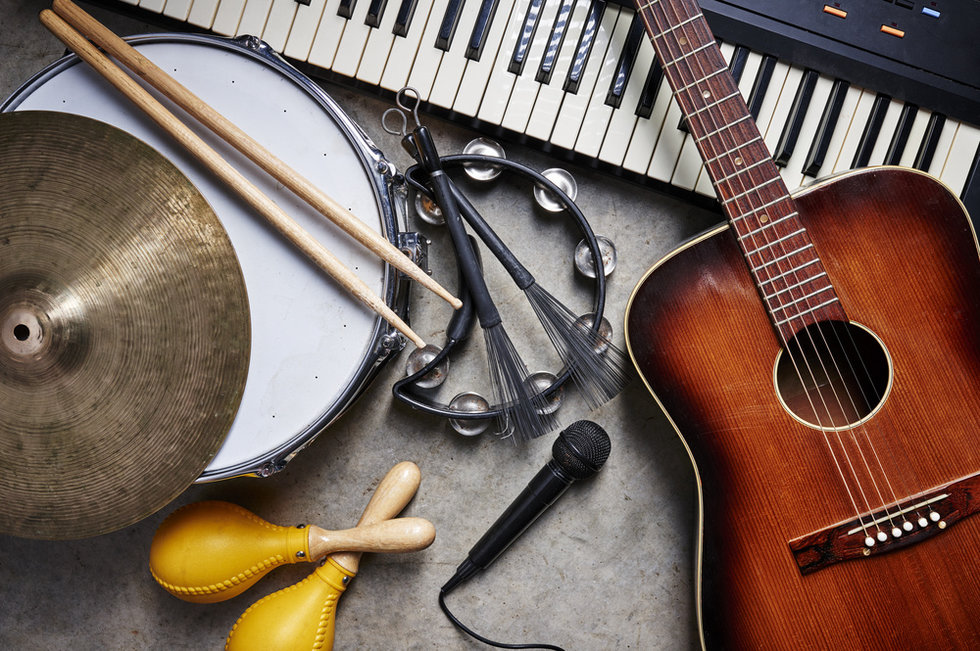
Since the advent of electronic instruments and the need by composers to produce unique and new sounds, many unusual instruments have been invented or restored to life. This is a list of the ten most bizarre instruments.

Aeolian Harp

The Aeolian Harp is a musical instrument that is “played” by the wind. It is named for Aeolus, the ancient Greek god of the wind. Aeolian harps were very popular as household instruments during the Romantic Era, and are still hand-crafted today. Some are now made in the form of monumental metal sound sculptures located on the roof of a building or a windy hilltop. The clip is a contemporary version – with a wind turbine provided the rhythm. The constant unchanging sound in the background is the Aeolian harp.


Ondes Martenot

The Ondes Martenot is an early electronic musical instrument with a keyboard and slide, invented in 1928 by Maurice Martenot and originally very similar in sound to the Theremin. The sonic capabilities of the instrument were subsequently expanded by the addition of filter banks and switchable loudspeakers. The instrument is especially known for its eerie wavering notes produced by the thermionic valves that produce oscillating frequencies. The ondes Martenot has been used by many composers, most notably Olivier Messiaen.


Theremin

The Theremin is one of the earliest fully electronic musical instruments. It was invented by Russian inventor Léon Theremin in 1919, and it is unique in that it was the first musical instrument designed to be played without being touched. It consists of two radio frequency oscillators and two metal antennas. The electric signals from the theremin are amplified and sent to a loudspeaker.


The Glass Armonica

The glass harmonica, also known as glass armonica, ‘”hydrocrystalophone” or simply armonica (derived from “armonia”, the Italian word for harmony) is a type of musical instrument that uses a series of glass bowls or goblets graduated in size to produce musical tones by means of friction, making it both a crystallophone and a friction idiophone). This mechanical version was invented by Benjamin Franklin.


Gravikord

The gravikord is an electric double harp invented and patented by Robert Grawi in 1986. It is modeled after the 21 string West African kora. It is made of welded stainless steel tubing, with 24 nylon strings but no resonating gourd or skin. The bridge is a synthetic material designed very differently from the kora and the range of pitches is greater. While the hands are in a more ergonomic and natural position to the strings, the playing technique is similar to that of the kora: the player plucks the strings with the thumb and index finger of each hand.


Read more at Listverse


Music makes everything better!

New research says singing daily reduces stress, clears sinuses, and helps you live longer 

Music makes everything better! It can relieve pain, reduces stress, makes you work harder, and helps you relax. Music is one of life's most beautiful gifts.

To quote Jimi Hendrix:
Music doesn't lie. If there is something to be changed in this world, then it can only happen through music.
One of the best ways to capture the benefits of music is through singing. It allows you to truly feel the song with your mind, body, and soul.

Research has shown singing can improve your health, increase happiness and even extend your life!


No matter who or where you are, you can reap the many benefits of music by singing along to some tunes! Sing wherever you are.

Singing is even good for your brain and can make you feel high. It releases endorphins, hormones that produce pleasure, simultaneous to oxytocin, hormones that diminish stress and anxiety.

Oxytocin also decreases feelings of depression and loneliness, making us feel more connected with the world, which is precisely why singing with other people feels even better!


A study done by scientists at the University of Gothenburg in Sweden found people who sing together become so connected they exhibit synchronized heartbeats.


Anyone who has ever been in choir can attest to this. When the magical sound of several people singing together is created, there is an unexplained unity between those singing.

Singing also requires deep concentration on breathing, which works major muscle groups in the upper body and is great for both lung and cardiovascular health.

Björn Vickhoff, the leader of the study, stated:

Song is a form of regular, controlled breathing, since breathing out occurs on the song phrases and inhaling takes place between these. It gives you pretty much the same effect as yoga breathing. It helps you relax, and there are indications that it does provide a heart benefit.

Therefore, one could make the argument that singing is better for you than doing yoga!

Research has also proven that singing produces lower levels of cortisol, reducing stress while improving our immune systems.

Lastly, a joint study from Harvard and Yale Universities in 2008 found singing increases life expectancy. If you want to feel less stressed, become happier, and live longer: Start singing!

Read more