1. Early musical training helps develop brain areas involved in language and reasoning. It is thought that brain development continues for many years after birth. Recent studies have clearly indicated that musical training physically develops the part of the left side of the brain known to be involved with processing language, and can actually wire the brain’s circuits in specific ways. Linking familiar songs to new information can also help imprint information on young minds.
2. There is also a causal link between music and spatial intelligence (the ability to perceive the world accurately and to form mental pictures of things). This kind of intelligence, by which one can visualize various elements that should go together, is critical to the sort of thinking necessary for everything from solving advanced mathematics problems to being able to pack a book-bag with everything that will be needed for the day.
3. Students of music learn craftsmanship as they study how details are put together painstakingly and what constitutes good, as opposed to mediocre, work. These standards, when applied to a student’s own work, demand a new level of excellence and require students to stretch their inner resources.
4. In music, a mistake is a mistake; the instrument is in tune or not, the notes are well played or not, the entrance is made or not. It is only by much hard work that a successful performance is possible. Through music study, students learn the value of sustained effort to achieve excellence and the concrete rewards of hard work.
5. Music study enhances teamwork skills and discipline. In order for an orchestra to sound good, all players must work together harmoniously towards a single goal, the performance, and must commit to learning music, attending rehearsals, and practicing.
6. Music provides children with a means of self-expression. Now that there is relative security in the basics of existence, the challenge is to make life meaningful and to reach for a higher stage of development. Everyone needs to be in touch at some time in his life with his core, with what he is and what he feels. Self-esteem is a by-product of this self-expression.
7. Music study develops skills that are necessary in the workplace. It focuses on “doing,” as opposed to observing, and teaches students how to perform, literally, anywhere in the world. Employers are looking for multi-dimensional workers with the sort of flexible and supple intellects that music education helps to create as described above. In the music classroom, students can also learn to better communicate and cooperate with one another.
8. Music performance teaches young people to conquer fear and to take risks. A little anxiety is a good thing, and something that will occur often in life. Dealing with it early and often makes it less of a problem later. Risk-taking is essential if a child is to fully develop his or her potential.
Music has proven time and again to be an important component of human
culture. From its ceremonial origin to modern medical usage for
personal motivation, concentration, and shifting mood, music is a
powerful balm for the human soul. Though traditional “music therapy”
encompasses a specific set of practices, the broader use of music as a
therapeutic tool can be seen nowadays as doctors are found recommending
music for a wide variety of conditions.
Music Helps Control Blood Pressure and Heart-Related Disorders
According to The Cardiovascular Society of Great Britain,
listening to certain music with a repetitive rhythm for least ten
seconds can lead to a decrease in blood pressure and a reduced heart
rate. Certain classical compositions, if matched with human body’s
rhythm, can be therapeutically used to keep the heart under control. The
Oxford University study states, “listening to music with a repeated
10-second rhythm coincided with a fall in blood pressure, reducing the
heart rate” and thus can be used for overcoming hypertension.
Listening and Playing Music Helps Treat Stress and Depression
When it comes to the human brain, music is one of the best medicines. A study at McGill University in Canada
revealed that listening to agreeable music encourages the production of
beneficial brain chemicals, specifically the “feel good” hormone known
as dopamine. Dopamine happens to be an integral part of brain’s
pleasure-enhancing system. As a result, music leads to great feeling of
joy and bliss.
It’s not only listening to music that has a positive effect on stress and depression. The Namm Foundation
has compiled a comprehensive list of benefits of playing music, which
includes reducing stress on both the emotional level and the molecular
level. Additionally, studies have shown that adults who play music
produce higher levels of Human Growth Hormone (HgH), which according to Web MD,
is a necessary hormone for regulating body composition, body fluids,
muscle and bone growth, sugar and fat metabolism, and possibly heart
function.
For more on how music can be composed to benefit the brain, read about States of Consciousness and Brainwave Entrainment.
Music Therapy Helps Treat Alzheimer’s Disease
Music
therapy has worked wonders on patients suffering from Alzheimer’s
disease. With Alzheimer’s, people lose their capacity to have
interactions and carry on with interactive communications. According to
studies done in partnership with the Alzheimer’s Foundation of America,
“When used appropriately, music can shift mood, manage stress-induced
agitation, stimulate positive interactions, facilitate cognitive
function, and coordinate motor movements.”
Studying Music Boosts Academic Achievement in High Schoolers
Early
exposure to music increases the plasticity of brain helping to motivate
the human brain’s capacity in such a way that it responds readily to
learning, changing and growing. “UCLA professor James S. Catterall analyzed the academic achievement
of 6,500 low-income students. He found that, by the time these students
were in the 10th grade, 41.4% of those who had taken arts courses
scored in the top half on standardized tests, contrasted with only 25%
of those who had minimal arts experience. The arts students also were
better readers and watched less television.” This goes to show that in
the formative stages of life, kids who study music do much better in
school.
Playing Guitar (and Other Instruments) Aids in Treating PTSD
The U.S. Department of Veterans Affairs
shared a study in which veterans experiencing Post Traumatic Stress
Disorder (PTSD) experienced relief by learning to play guitar. The
organization responsible for providing guitars, Guitars For Vets
“enhances the lives of ailing and injured military Veterans by
providing them free guitars and music instruction.” Playing music for
recovery from PTSD resembles traditional music therapy, in which
patients are encouraged to make music as part of their healing process.
Guitar is not the only instrument that can help PTSD. In fact, Operation We Are Here has an extensive list of Therapeutic Music Opportunities For Military Veterans.
Studying Music Boosts Brain Development in Young Children
A research-based study undertaken at the University of Liverpool
in the field of neuroscience has light to shed on the beneficial
effects of early exposure to music. According to the findings, even half
an hour of musical training is sufficient to increase the flow of blood
in the brain’s left hemisphere, resulting in higher levels of early
childhood development.
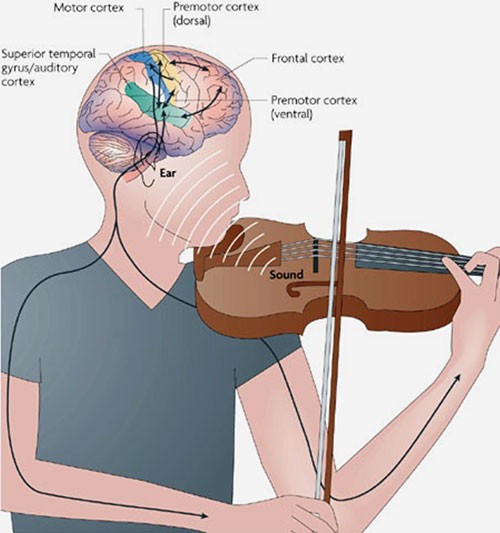
The Portland Chamber Orchestra
shares, “Playing a musical instrument involves multiple components of
the central (brain and spinal cord) and peripheral (nerves outside the
brain and spinal cord) nervous systems. As a musician plays an
instrument, motor systems in the brain control both gross and fine
movements needed to produce sound. The sound is processed by auditory
circuitry, which in turn can adjust signaling by the motor control
centers. In addition, sensory information from the fingers, hands and
arms is sent to the brain for processing. If the musician is reading
music, visual information is sent to the brain for processing and
interpreting commands for the motor centers. And of course, the brain
processes emotional responses to the music as well!”
Music Education Helps Children Improve Reading Skills
Journal Psychology of Music
reports that “Children exposed to a multi-year program of music tuition
involving training in increasingly complex rhythmic, tonal, and
practical skills display superior cognitive performance in reading
skills compared with their non-musically trained peers.” In the
initial stages of learning and development, music arouses auditory,
emotional, cognitive and visual responses in a child. Music also aids a
child’s kinesthetic development. According to the research-supported
evidence, a song facilitates language learning far more effectively than
speech.
Listening To Music Helps Improve Sleep
According to The Center for Cardiovascular Disease in China,
listening to music before and during sleep greatly aids people who
suffer from chronic sleep disorders. This “music-assisted relaxation”
can be used to treat both acute and chronic sleep disorders which
include everything from stress and anxiety to insomnia.
Playing Didgeridoo Helps Treat Sleep Apnea
A study published in the British Medical Journal shows that people suffering from sleep apnea can find relief by practicing the Australian wind-instrument known as the didgeridoo.
Patients who played the didgeridoo for an average of 30-minutes per
day, 6 days per week, saw significant increases in their quality of
sleep and decreases in daytime tiredness after a minimum period of
3-months of practice. Dr. Jordan Stern of
BlueSleep says, “The treatment of sleep apnea is quite challenging
because there is not a single treatment that works well for every
patient. The didgeridoo has been used to treat sleep apnea and it has
been shown to be effective in part because of strengthening of the
pharyngeal muscles, which means the muscles of the throat, as well as
the muscles of the tongue.”