Showing posts with label audio clip. Show all posts
Rhapsody In Blue: Gershwin At His Greatest
On June 23rd, 1959, Leonard Bernstein and the Columbia Symphony took their places at the St. George Hotel in Brooklyn, N.Y. and made a landmark recording of Gershwin's 'Rhapsody in Blue.'
Rhapsody In Blue, the first "serious" composition by George Gershwin (1898-1937), is likely to remain his most popular work in any form, more for its prodigious melodic richness rather than for any deeper expressiveness or structural brilliance.
In the hands of another composer, Rhapsody In Blue could easily have turned into a disjointed exercise in symphonically dressed up jazz rhythms, melodic figures and quasi-improvisatory instrumental licks. Instead, Gershwin's uncanny sense of timing, and a gift for memorable melody unparalleled in the 20th century, turned the Rhapsody into an embodiment of the Jazz Age's upbeat lyricism and dance-driven vitality. The roaring Twenties had a soul, and this was it.
The piece was composed in considerable haste, for a concert on February 12th, 1924, organized by jazz bandleader Paul Whiteman. It took place at New York's Aeolian Hall, billed as an "Experiment In Modern Music." The piece was scored for jazz band by Whiteman's arranger, the multitalented Ferde Grofé, and Gershwin himself played the piano solo — though at the time of the premiere he had not yet written it out. Grofé also scored the work's orchestral version.
Listen to the entire Rhaspsody in Blue
Possessed or Blessed
Niccolo
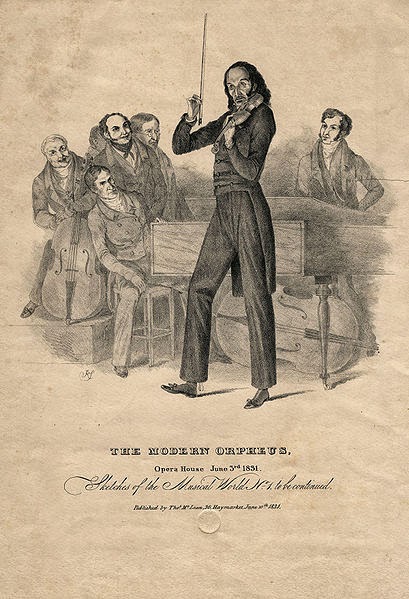
Paganini, who is considered the greatest violin virtuoso of all time,
was probably one of the most erratic figures of all time. Through his
numerous performances all over Europe, he enthralled and inspired every
audience, including musicians of his era.
![]() |
| Niccolò Paganini (1819), by Ingres |
Listen to Joshua Bell and Sharon Isbin perform Paganini's Cantabile at the White House Evening of Classical Music on 4 November 2009.
![]() |
| Hector Berlioz |
Paganini was considered a genius, a god, a devil worshiper, anything but that of reality. There was a rumor, for instance, that when Niccolo was only six, his mother made a pact with the Devil and is said to have traded his soul for a career as the greatest violinist in the world.
Paganini was a legend. In fact, he was so amazing no audience could succumb to any type of disturbance during the trance he created through his musical renditions. After borrowing a Guarnerius violin for a single concert, the lender begged him to keep it for fear of coming under Paganini's supernatural powers. He also won a Stradivarius violin in a similar manner by playing a technical piece by sight which was insisted that nobody could perform even after preparation.
| |
| 1831 bulletin advertising a performance of Paganini |
Whenever and wherever he played, he aroused tenor and awe in his audiences. There was the rumor that a satanic figure, a double of Paganini, always appeared in the audience in sombre black with the same long black locks, burning eyes, and sardonic smile. Or else the figure appeared on the stage at Paganini's side dressed in a red cloak and pantaloons, with horns, hooves, and a tail to guide Paganini's bow arm through a performance. It was believed that this figure raised a thunderstorm, during a concert and conducted lightening to the free end of the bow, and at another performance he actually took possession of Paganini's body. In spite of his appearance and the suspicions, however, he was worshiped wherever he went.
All parts of Europe were delighted with his music and women were spellbound at the sound of his hypnotic melodies. There was another rumor that he was the greatest womanizer of all time and that he killed a woman, imprisoned her soul in his violin, and used parts of her intestines as an eternal source of gut for his strings. The unearthly screams of women were sometimes heard coming from his violin as he played on stage.
Paganini was born of a poor family in 1782 at Genoa and showed a natural talent at a very early age. His father wanted his son to be a genius and did everything in his power to make that come true. He stood by him consistently when he practiced disciplining him severely with a rod that was seldom spared. His father was quite successful in his persistence for at the age of eight, he played a Pie yel Concerto in a Genoa church. He so enthralled the audience, that his playing became in great demand for local social gatherings. His teachers at that time were Giovanni Servetto and Giacomo Costa. When he turned nine, he made an official debut in a Genoa concert auditorium playing his own composition, La Carmagnole which is a theme and variations. By age thirteen, he was known throughout the town as the "wonderchild."
He continued with his studies in Leghorn with Ferdinando Paer and in Parma with Alessandro Rolla, which began his first extended concert tour. He succeeded rapidly in the cities of Lombardy playing many of his own electrifying compositions.
At the age of seventeen, he was on his own. He no longer needed financial assistance from his father and broke away assured of his talent. Freed for the first time of his father's strictness, he gave in to his two passions - women and gambling -- to which he was thenceforth to be addicted.
At the turn of the century, he disappeared from the public eye. It is generally believed that he fell in love with a Guscan noble lady and lived with her at her chateau. At this time, he abandoned the violin temporarily because of his mistress' wishes and concentrated his virtuoso and creative gifts on the guitar. He also composed several pieces and chamber works for the guitar. But, after three years, he returned to his native city to study, play, and compose at full intensity.
The most amazing stories were heard about his performances. The most famous is of the concert in Leghorn. When a string of his violin snapped in an intricate passage, the audience began expressing derision. But when Paganini continued to play the piece on three strings instead of four, the derision turned to wonder and awe. From then on Paganini would not hesitate to use this devise on purpose to further entrance his audience. Often he would use worn strings so that he could complete his performance on three or even two strings when they snapped. Later he got the idea to write entire pieces for a single string, such as the Fantasia on the G String.
By 1813, Paganini became the greatest violinist of his day and the most worshiped. He spent the next decade and a half performing numerous concerts throughout Italy. His health, however, was turning bad which limited his touring voyages to his own country. When he finally left his country to perform in other parts of Europe, the concert halls were filled immediately and crowds rushed to see for themselves the creature that was so talked about. In 1828, he was in Vienna where he hypnotized his audience. Everyone was talking about him. Snacks and billiard shots were named after him.
After Vienna, he traveled extensively throughout Germany and in 1831, he arrived in Paris, his ultimate goal. In Paris, there was a study made of him because his unusual appearance created an abnormal "presence" about him. Up until then there was no challenge as to the idea that he was possessed by the devil or was some sort of god himself. Through this study, however, it was found that his physical characteristics were linked to his mental abilities; the same qualities which characterize a genius.
In his tour to England and Scotland, Paganini made the largest sum of money that any performing artist had earned up to that time in a single trip.
He returned to Italy and purchased an estate near Parma where he made several concert appearances despite his suffering from poor health. He lost some of his fortune in a gambling house named after him, thus making him restless and weary. He started coughing and eventually lost his voice completely in 1838. He went to Nice for a rest cure - but neither rested nor was cured. He spent his last hours improvising feverishly on his violin, defying his rapidly waning strength. Finally, he died on May 27, 1840.
![]() |
| Paganini on his death bed |
For five years the Church, disturbed as to his orthodoxy, refused his body interment in consecrated ground, and so it was laid to rest in a village graveyard on his own estate. The people in nearby towns use to say that every night they heard the sounds of a ghostly violin emanating from that coffin. The legend of Paganini's life lasted until the very end.
Reposted From Guitarra Magazine
Why Being Stuck On A Tarmac With The Philly Orchestra Rocks
There are few things as annoying as being stuck on a tarmac — in a cramped, packed plane — for long periods of time. But when you have some of the members of the Philadelphia Orchestra on your flight, it could turn magical.
No, seriously.
It happened to passengers on a flight from Beijing to Macau, this week. They had been sitting on the tarmac for three hours when a quartet of musicians from the Philadelphia Orchestra pulled out their instruments and provided a "Pop Up" performance.
The orchestra published video of the performance:
.
No, seriously.
It happened to passengers on a flight from Beijing to Macau, this week. They had been sitting on the tarmac for three hours when a quartet of musicians from the Philadelphia Orchestra pulled out their instruments and provided a "Pop Up" performance.
The orchestra published video of the performance:
.
Playing Mozart — On Mozart's Violin
The violin and viola that played himself are in the United States for the first time ever. The instruments come out of storage only about once a year at the Salzburg Mozarteum in Austria. The rest of the time, they're kept under serious lockup. Musicians who got to play them aearlier this week before the violin's New York premiere on June 14th.
Rhapsody In Blue: Gershwin At His Greatest
On June 23rd, 1959, Leonard Bernstein and the Columbia Symphony took their places at the St. George Hotel in Brooklyn, N.Y. and made a landmark recording of Gershwin's 'Rhapsody in Blue.'
Rhapsody In Blue, the first "serious" composition by George Gershwin (1898-1937), is likely to remain his most popular work in any form, more for its prodigious melodic richness rather than for any deeper expressiveness or structural brilliance.
In the hands of another composer, Rhapsody In Blue could easily have turned into a disjointed exercise in symphonically dressed up jazz rhythms, melodic figures and quasi-improvisatory instrumental licks. Instead, Gershwin's uncanny sense of timing, and a gift for memorable melody unparalleled in the 20th century, turned the Rhapsody into an embodiment of the Jazz Age's upbeat lyricism and dance-driven vitality. The roaring Twenties had a soul, and this was it.
The piece was composed in considerable haste, for a concert on February 12th, 1924, organized by jazz bandleader Paul Whiteman. It took place at New York's Aeolian Hall, billed as an "Experiment In Modern Music." The piece was scored for jazz band by Whiteman's arranger, the multitalented Ferde Grofé, and Gershwin himself played the piano solo — though at the time of the premiere he had not yet written it out. Grofé also scored the work's orchestral version. Listen to the entire Rhaspsody in Blue
Richie Havens
Richie Havens once told NPR that he believed all music is folk music. Listen to Havens speak about Woodstock, Greenwich Village and why he loved performing in Neda Ulaby's remembrance, broadcast on Morning Edition, at the audio link on this page.
Classical Masterpieces Turn Up in Cartoons
Music Historian Rober Greenberg talks about the way cartoons draw on an unlikely music source:
Cartoons made in the 1940s and '50s featured characters like Bugs Bunny, Woody Woodpecker and Elmer Fudd pretending to play significant operatic and symphonic works or feuding with their sworn enemies to the tune of epic masterpieces. Many children became familiar with classical music through these cartoons. Music historian Robert Greenberg talks about how that came to be and discusses the impact of cartoons on classical music.
Bugs Bunny was quite the concert musician. In "Rhapsody Rabbit," he attempted to perform Liszt's "Hungarian Rhapsody No. 2" despite a coughing audience member (whom Bugs shoots), a ringing telephone and a bothersome mouse. He conducted an orchestra at the Hollywood Bowl in "Long-Haired Hare."
The animated films Fantasia and The Sorcerer's Apprentice featured many different musical works. Fantasia, from 1940, featured music from Mussorgsky and Schubert. The film marked an attempt to create an "integrated" art form — what Wagner called Gesamtkunstwerke, a virtual reality that combined music and animation and virtually no dialogue. The music was recorded under the direction of Leopold Stokowski, with seven numbers performed by the Philadelphia Orchestra. The Sorcerer's Apprentice was originally a stand alone film based on a story by Goethe and the music of Paul Dukas. At Stokowski's suggestion, Disney expanded the film into Fantasia, which also featured music by Bach, Tchaikovsky and Stravinsky.
Cartoons made in the 1940s and '50s featured characters like Bugs Bunny, Woody Woodpecker and Elmer Fudd pretending to play significant operatic and symphonic works or feuding with their sworn enemies to the tune of epic masterpieces. Many children became familiar with classical music through these cartoons. Music historian Robert Greenberg talks about how that came to be and discusses the impact of cartoons on classical music.
| The Los Angeles Philharmonic performs at the Hollywood Bowl as the cartoon "Baton Bunny" plays overhead. |
Bugs Bunny was quite the concert musician. In "Rhapsody Rabbit," he attempted to perform Liszt's "Hungarian Rhapsody No. 2" despite a coughing audience member (whom Bugs shoots), a ringing telephone and a bothersome mouse. He conducted an orchestra at the Hollywood Bowl in "Long-Haired Hare."
The animated films Fantasia and The Sorcerer's Apprentice featured many different musical works. Fantasia, from 1940, featured music from Mussorgsky and Schubert. The film marked an attempt to create an "integrated" art form — what Wagner called Gesamtkunstwerke, a virtual reality that combined music and animation and virtually no dialogue. The music was recorded under the direction of Leopold Stokowski, with seven numbers performed by the Philadelphia Orchestra. The Sorcerer's Apprentice was originally a stand alone film based on a story by Goethe and the music of Paul Dukas. At Stokowski's suggestion, Disney expanded the film into Fantasia, which also featured music by Bach, Tchaikovsky and Stravinsky.
Dr. Fuddle's Top Ten Composers
7. Franz Liszt
(1811-1886), Hungarian romantic pianist and composer, most noted for being the first musical “superstar,” the greatest pianist of all time, creating some of the most demanding virtuoso piano music in the repertoire, such as the Sonata in b minor, the Mephisto Waltz, the Transcendental Etudes, Hungarian Rhapsodies; also noted for his development of the symphonic poem.
Listen to Nocturne in A flat Major No. 3 (Liebestraume - Dream of Love - Love Dreams) & Excerpts from Hungarian Rhapsody No. 2 in C Sharp
(1811-1886), Hungarian romantic pianist and composer, most noted for being the first musical “superstar,” the greatest pianist of all time, creating some of the most demanding virtuoso piano music in the repertoire, such as the Sonata in b minor, the Mephisto Waltz, the Transcendental Etudes, Hungarian Rhapsodies; also noted for his development of the symphonic poem.
Listen to Nocturne in A flat Major No. 3 (Liebestraume - Dream of Love - Love Dreams) & Excerpts from Hungarian Rhapsody No. 2 in C Sharp
Dr. Fuddle's Top Ten Composers
9. Peter Ilyich Tchaikovsky
In honor of his First Piano Concerto, his six symphonies and music for ballets.
Music samples
Dr. Fuddle's Top Ten Composers!
10 . FRANZ SCHUBERT
In honor of his piano pieces, songs and symphonies!
(1797 – 1828)
Franz Peter Schubert (1797-1828) was an Austrian composer. He wrote some 600 lieder, nine symphonies
(including the famous “Unfinished Symphony”), liturgical music, operas,
and a large body of chamber and solo piano music. He is particularly
noted for his original melodic and harmonic writing.
Mass No. 2 in G, D. 167
Performance by the MIT Concert Choir
Piano sonata in B♭, D. 960 (composed in 1828)
Performed by Randolph Hokanson
Examples of Works for violin and piano
Classical 'Rock Star' Joshua Bell Takes On Conducting
Joshua Bell,
the violin prodigy who grew into what some call a classical-music rock
star, has taken the helm of the Academy of St. Martin in the Fields.
Bell is the orchestra's first music director since Sir Neville Marriner,
who created the group.
On his first tour
with the group as both music director and conductor, Bell plays the
violin while conducting the orchestra simultaneously, gesturing with his
bow. And he leads from the concert master's chair, rather than the
podium, which seems unusual to some audiences.
But
the ASMF orchestra "really knows how to read those sorts of cues," he
tells NPR's Neal Conan. In fact, Bell says, Marriner originally led the
orchestra from the violin, too.
"So this orchestra, their roots come from being directed from the chair," he says. "Not with a stick."
Subscribe to:
Posts (Atom)